Quick Answer: How Should You Position a 4-Sided Midway Booth?
A 4-sided midway booth layout works best where visitors can approach its four open play sides without blocking the venue's main walking routes. LIONET's published model measures 5,100 × 5,100 × 4,200 mm, weighs 1,600 kg, and has a listed 3,200 W power requirement. Those are equipment specifications—not a complete operating-area measurement. A realistic plan must also provide room for active players, waiting guests, spectators, staff access, and power routing.
For an outdoor festival, amusement park, resort, or cultural attraction, evaluate the booth as a four-direction play zone, not merely a large object to fit into an empty square.
Why Four-Sided Play Changes the Venue Layout
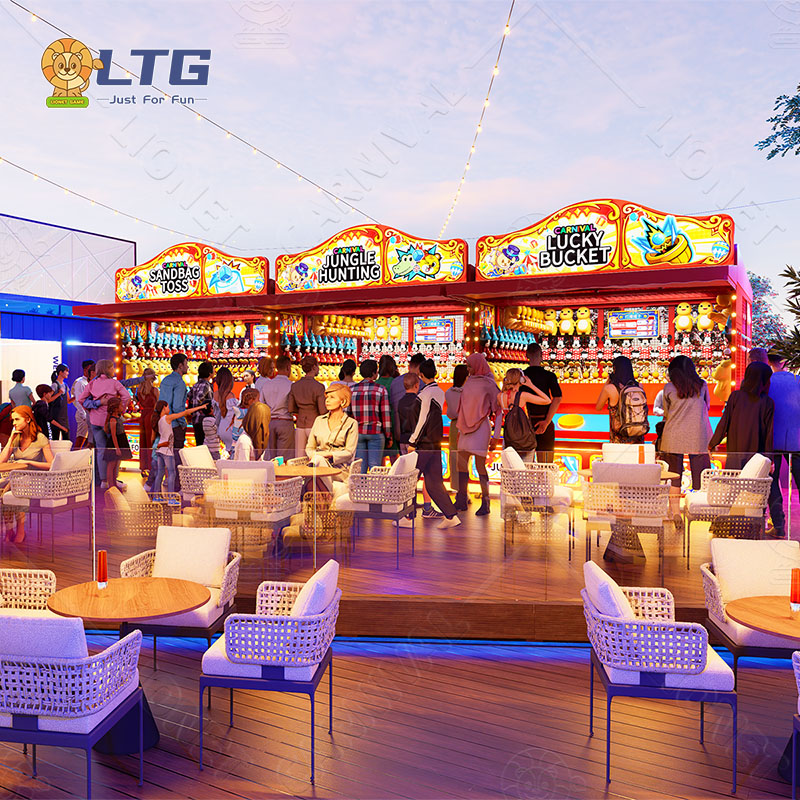
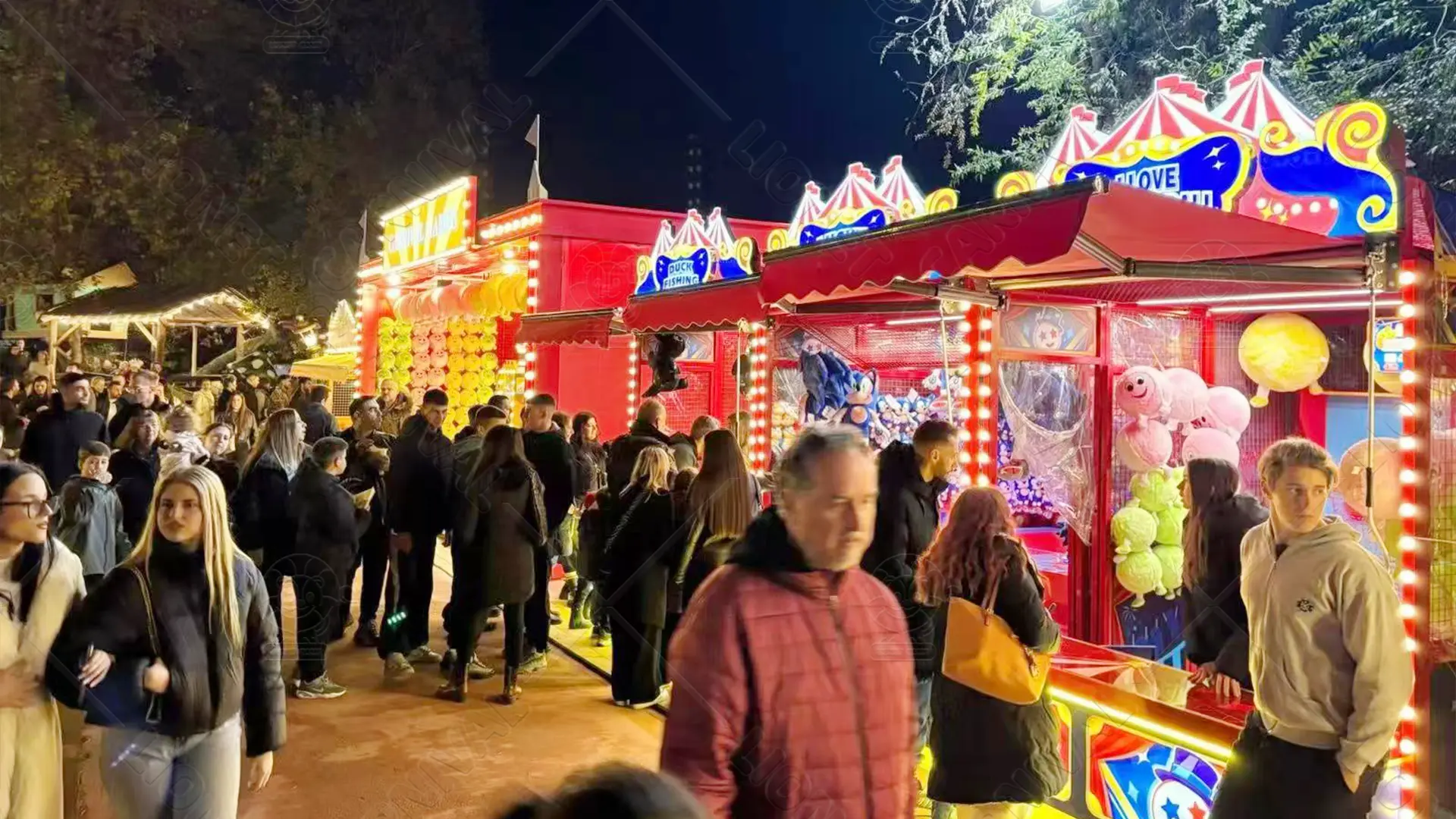
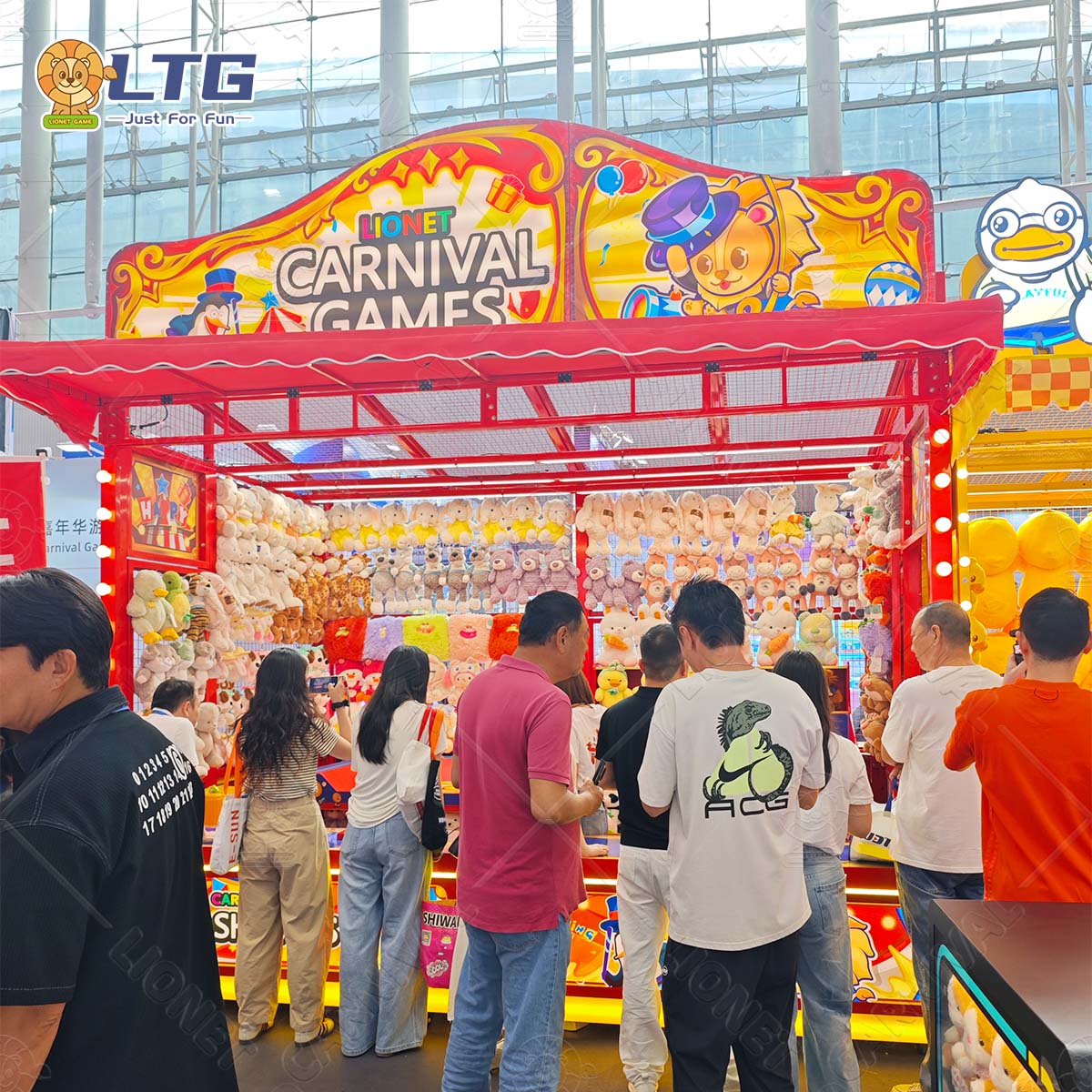
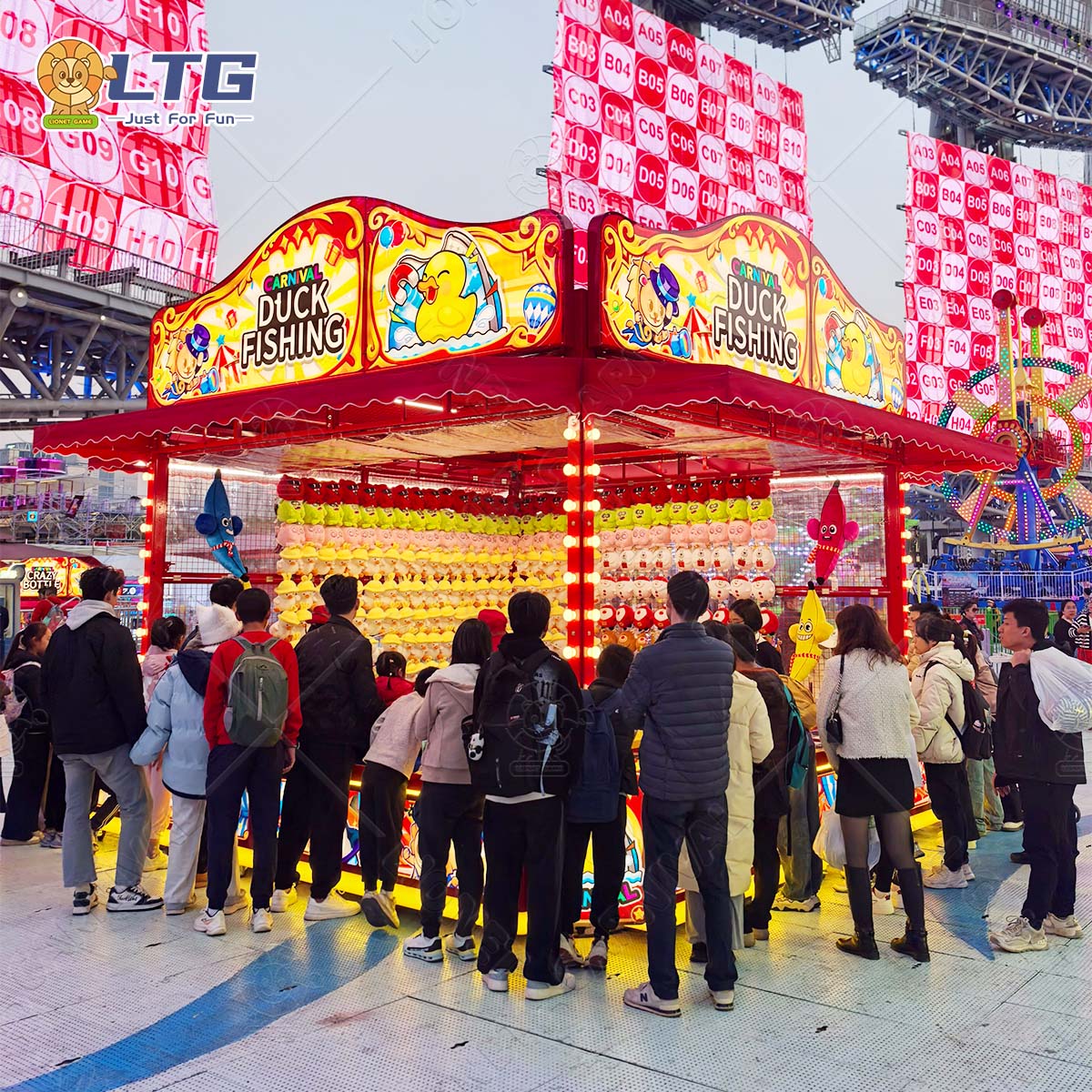
A conventional midway lineup often presents games along a primary guest-facing edge. LIONET's 4-Sided Midway Booth takes a different approach: guests can reach the attraction from all four directions, and multiple players can participate at the same time. The colorful circus-style frame creates a visible landmark, while the open-sided concept changes how a venue operator should arrange nearby foot traffic.
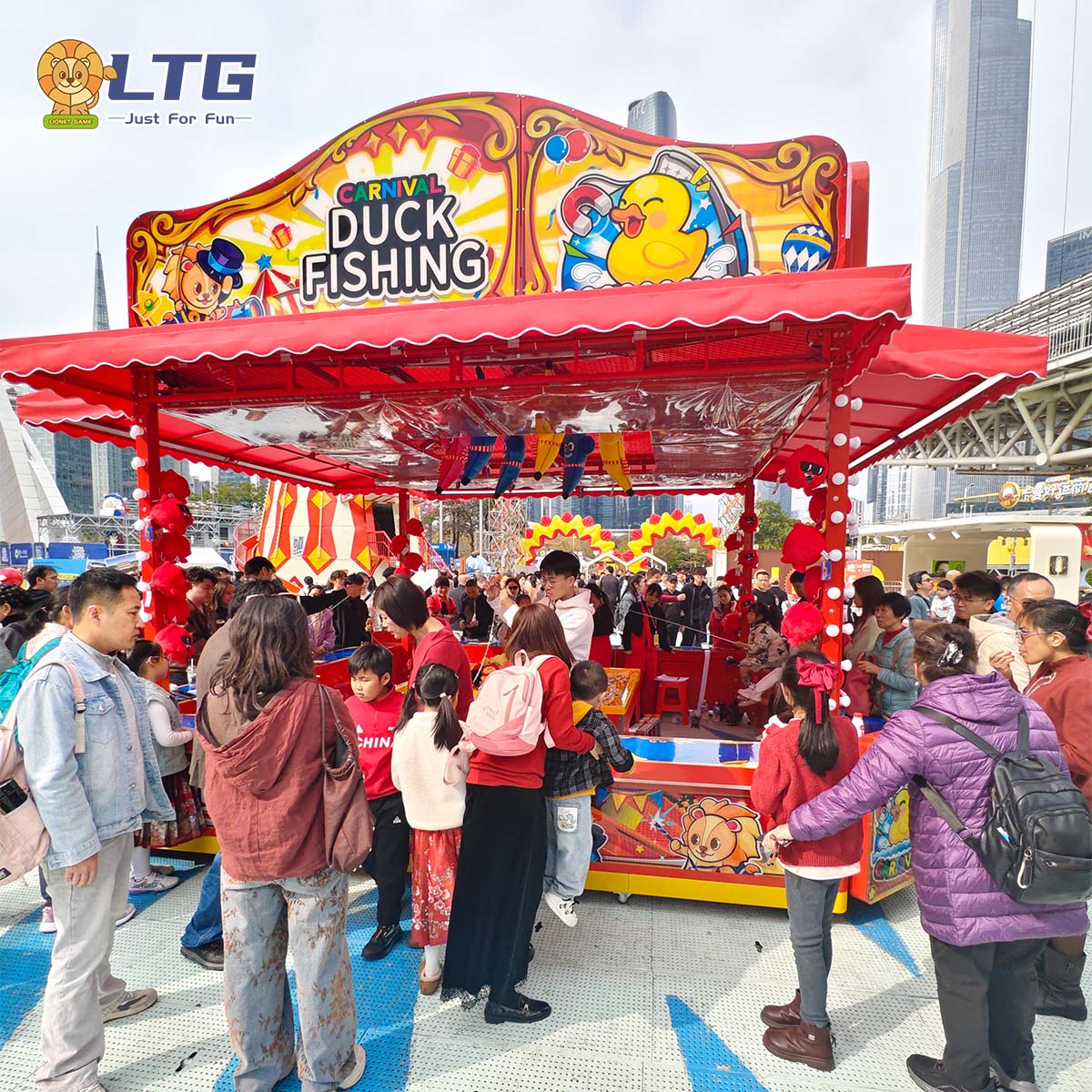
This design has three practical implications:
- Approach is multidirectional. Guests may discover the game from several paths instead of walking along a single booth front.
- Watching and playing can overlap. Friends and families may pause to observe, so spectators need a position that does not interfere with the active playing area.
- The surrounding space matters as much as the booth. A central attraction is only useful when queues, guest circulation, and staff access remain manageable.
For a China-based original carnival game manufacturer such as LIONET, the value of an original design is not only its appearance. It is also how its physical format and selectable game content serve the operator's intended venue.
Who should consider this booth—and who should be cautious?
A good starting fit is a park with an open plaza, a festival site with broad access from several directions, a resort activity zone, or a seasonal entertainment area that wants a central midway feature. The four-sided arrangement is especially relevant when the venue can allocate dedicated space around every active side.
A less suitable starting fit is a narrow walkway, a small indoor corridor, or a site where people can only reach one face. In those conditions, a conventional front-oriented booth may be simpler to plan. Buyers should compare the intended site shape—not choose the largest booth simply because it appears more impressive.
Published 4-Sided Midway Booth Specifications
The following facts are published on LIONET's official 4-Sided Midway Booth product page. They provide the starting point for venue and procurement discussions.
| Specification | Published detail | Why it matters to the buyer |
|---|---|---|
| Product | 4-Sided Midway Booth | Identifies the specific model |
| Intended environment | Outdoor carnival and open-air entertainment | Helps match venue type |
| Play access | Four open sides | Requires planning on all four sides |
| Players | Multiple players; exact number not stated on this product page | Confirm the configuration before forecasting capacity |
| Dimensions (W × D × H) | 5,100 × 5,100 × 4,200 mm | Starting envelope for site drawings |
| Weight | 1,600 kg | Relevant to unloading and movement planning |
| Listed power | 3,200 W | Starting point for the electrical discussion |
| Materials | Acrylic and metal | Identifies published material categories |
| Mobility | Caster wheels | Discuss repositioning and handling procedures |
| Canopy | Rain and sun protection | Discuss real-world exposure and operating instructions |
| Game system | Game content and game frame are separate parts | Supports discussion of game selection and future changes |
| Published MOQ | 1 unit | Starting point for an initial purchase inquiry |
Important distinction: The 5,100 × 5,100 mm dimensions describe the equipment, not a complete venue footprint. The product page does not publish a minimum perimeter clearance, fixed number of simultaneous player stations, operating voltage, delivery package size, or universal setup time. Ask LIONET to confirm these details for the selected configuration instead of assuming them.
4-Sided Midway Booth Layout: Six Steps for Four-Way Guest Flow
A four-sided carnival booth layout should begin with the movement of people. The following planning method is a buyer's checklist, not an engineering drawing or a claim about fixed spacing requirements.
Step 1: Mark the exact equipment envelope
Place a 5.1 m × 5.1 m equipment outline on your site plan, then account for the published 4.2 m overall height. Mark nearby building edges, other attractions, temporary structures, overhead decorations, and entrance routes. If your venue has uneven or limited ground conditions, discuss them before deciding the booth position.
Request a configuration drawing for the model being ordered. This helps the site team distinguish the published overall dimensions from the actual boundaries needed to load, position, and operate the equipment.
Step 2: Draw an approach area on every usable side
Start with four directions—north, south, east, and west—or the equivalent orientations on your site. Mark where guests will come from and where they will leave after a round. A four-sided booth does not mean all four approaches must handle identical crowds; foot traffic may be much higher near the main event entrance.
Do not place the booth so close to a wall, fence, or neighboring attraction that a nominally open side becomes unusable. If only two sides can be accessed, ask whether a different booth format would be a better operational fit.
Step 3: Separate the active-player, waiting, and spectator areas
For each operating side, distinguish three groups: guests currently playing, guests waiting for a turn, and people watching. The precise arrangement depends on the game selected, the number of usable positions, and venue attendance.
A practical site sketch should label:
| Site zone | Planning question |
|---|---|
| Equipment boundary | Where does the 5.1 m square model sit? |
| Active play area | Where do players stand and perform the selected game? |
| Waiting area | Can a queue form without entering a neighboring game zone? |
| Spectator space | Can people watch without blocking players or walking routes? |
| Staff and prize access | How can the operating team reach game supplies and prizes? |
| Through route | Can nonparticipants walk past without cutting through a queue? |
There is no universal queue depth or player-space dimension in the published product specification. The venue team should set practical values based on the chosen gameplay, anticipated audience, and the final equipment drawing.
Step 4: Keep the four approaches from competing with one another
The biggest planning mistake is to treat four access faces as four independent attractions while allowing the same space to be claimed by several queues. At a busy fair, two adjacent sides might attract viewers from the same main path. Without clear staging areas, waiting guests could spill into the walkway.
Before approving the placement, draw the expected route of a visitor who notices the booth, joins the game, finishes, and leaves. Repeat the exercise from all four sides. Where two routes cross, consider shifting the equipment position, changing the queue direction, or using venue-managed wayfinding.
Step 5: Plan the electrical connection and operator access
LIONET lists 3,200 W for the model. This figure is not a substitute for a final electrical specification. Confirm the required voltage, frequency, connection arrangement, actual game configuration, and operating instructions with the manufacturer before assigning a supply point.
Similarly, the public description does not establish how many attendants every venue must use. Staffing depends on the game chosen, the guest profile, payment or ticket collection method, prize handling, and the operator's service model. Keep an accessible service approach in the proposed layout rather than assuming the booth can be managed from any position.
Step 6: Validate delivery, positioning, and outdoor operation
At a published 1,600 kg, this is a substantial piece of entertainment equipment. Caster wheels are a product feature, but they do not remove the need to review unloading, transport within the venue, ground conditions, assembly details, and safe repositioning instructions.
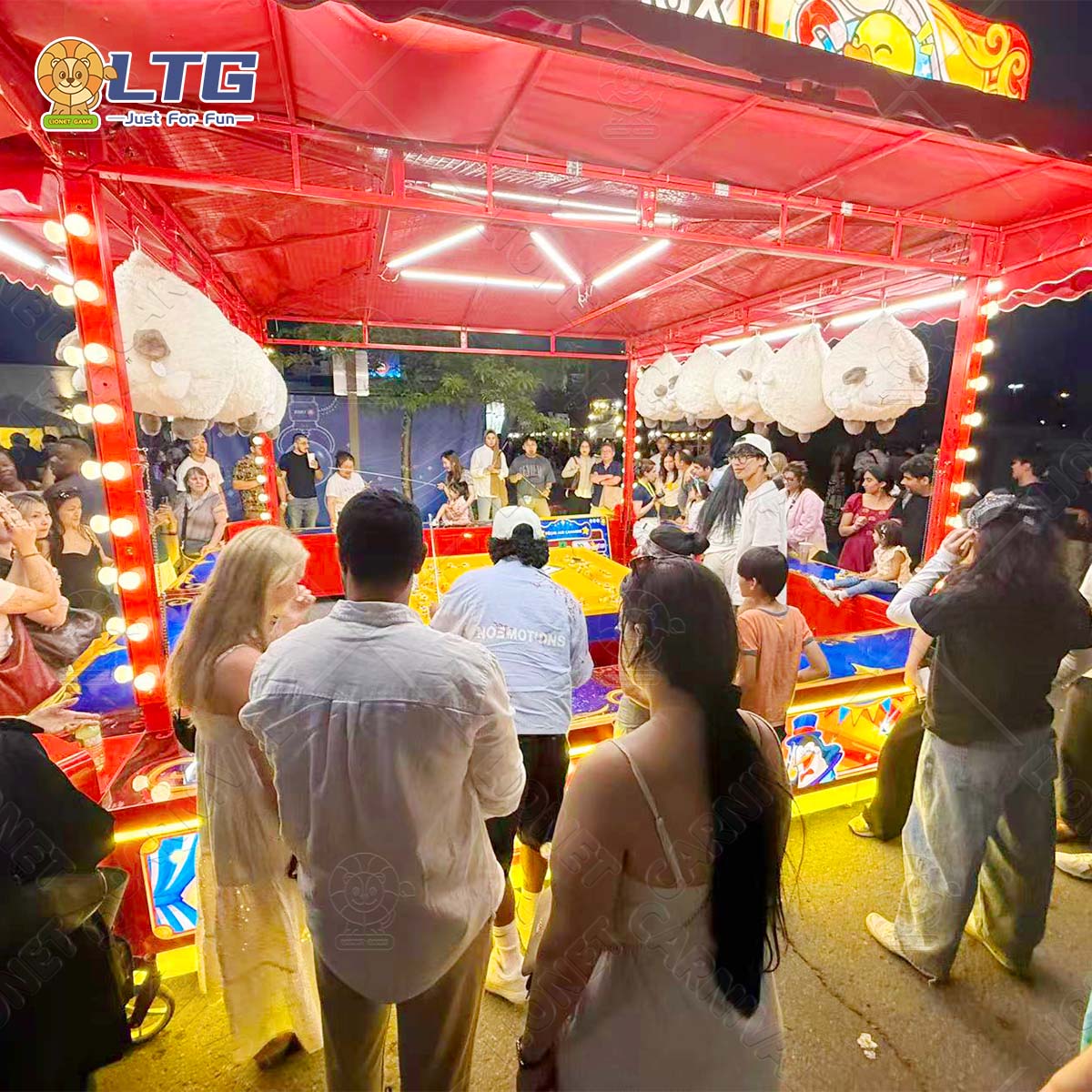
The booth also includes a canopy described as offering protection from rain and sun. That should not be interpreted as a published waterproof rating or a guarantee of operation in every weather condition. Request the applicable use and care instructions for the venue's climate and event schedule.
Choose Game Content to Match Your Audience
The four-sided frame is described as a two-part modular system, with game content and the surrounding game frame treated separately. This gives buyers a useful way to discuss the game mix during the purchasing process. LIONET lists ball toss, ring toss on glass bottles, lucky toss, duck fishing, and coin toss among the available choices.
A venue should not select game names only by appearance. Instead, review how each game will be played and operated in the final booth arrangement.
| Listed game option | Useful questions before confirming the configuration |
|---|---|
| Ball toss | What are the targets, play distance, and round-reset steps? |
| Ring toss on glass bottles | What is supplied, and how should the operator handle and replace game components? |
| Lucky toss | How is the objective explained to a first-time player? |
| Duck fishing | How are game elements prepared, handled, and reset between turns? |
| Coin toss | What is the play sequence and how are results confirmed? |
The questions above are selection prompts, not claims that a specific mechanism, scoring system, automatic reset feature, or prize rule is included. Ask for the actual game list and a demonstration of the selected combination.
A modular frame is useful only when the change process is clear
LIONET's product description separates the game frame from the game content. That creates a meaningful conversation about future activity changes, but it does not specify that every game can be exchanged in a fixed number of minutes or without new parts. For repeat seasonal use, ask which components are shared, which are game-specific, and what an operator must do to change the setup.
For an event operator, the most useful supplier documentation is often straightforward: a final included-parts list, an explanation of the chosen games, visual setup instructions, operating steps, and a clear method for obtaining replacement components.
Four-Sided Versus Front-Oriented Midway Booths
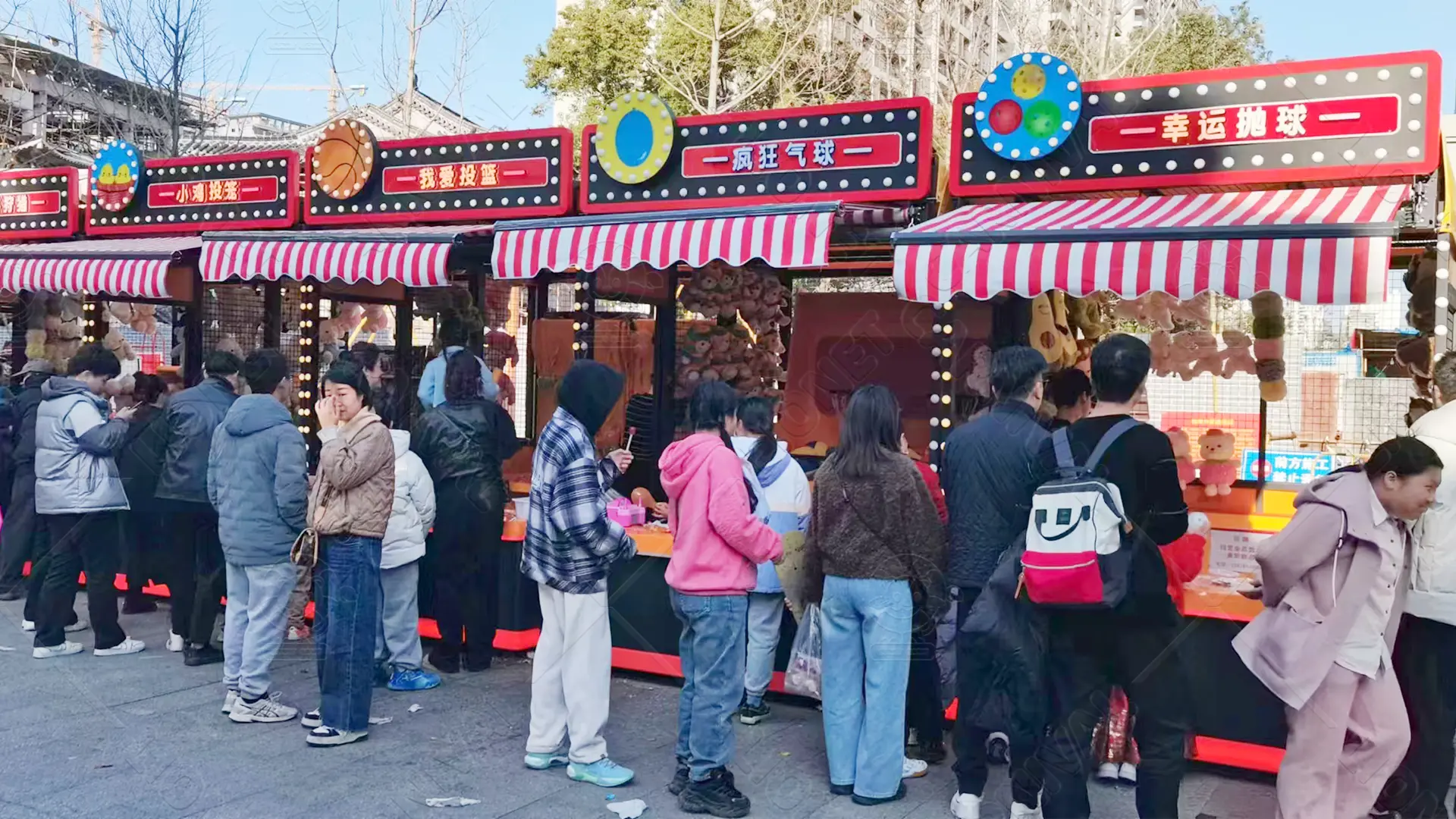
The 4-Sided Midway Booth is not simply a wider version of a standard booth. Its key distinction is the direction from which players can approach. LIONET also publishes conventional outdoor midway models that buyers can use as alternatives.
| LIONET model | Published player arrangement | Layout discussion |
|---|---|---|
| 3m Standard Midway Booth | Three players | Consider for a regular game lineup with a clear primary guest-facing area |
| 4m Outdoor Midway Booth | Four players | Consider when a larger front-facing midway presence fits the site |
| 4-Sided Midway Booth | Multiple players from four directions | Consider when the venue can support active access and circulation around every side |
When evaluating a 4-sided midway booth layout, the right format depends on available circulation space, the number of accessible play faces, audience movement, and the desired game experience. A narrow site may benefit more from a line of conventional booths; a broad square may provide a better opportunity for a four-sided centerpiece. Do not compare projected revenue or hourly throughput unless your venue has real operating data for the selected game configuration.
What Original Design and Manufacturing Mean for B2B Buyers
LIONET positions itself as a China-based designer and manufacturer of original carnival games. For a procurement team, that positioning becomes useful when it is connected to identifiable product decisions: four-direction access, the visible circus-style frame, caster-supported movement, canopy protection, and a frame/game-content arrangement.
Buyers can evaluate these details through practical questions rather than unsupported promises:
- Design fit: Does the published booth structure match the venue's real circulation pattern and visual theme?
- Game clarity: Can a first-time guest understand the selected game's objective and completion condition?
- Material information: Are the listed acrylic and metal components identified clearly in the final product documentation?
- Assembly and handling: Are the delivery pieces, unloading method, positioning procedure, and required equipment specified?
- Operation: Can staff explain each game, manage supplies, and carry out ordinary resets using the supplied instructions?
- After-purchase support: What replacement items and communication process are available for the selected configuration?
These are items to confirm with LIONET, not blanket claims that every order contains a particular accessory, performance result, or service package.
Pre-Order Checklist: What to Send LIONET
A good B2B inquiry is more useful when the buyer shares the actual venue rather than requesting only a price. Include the following details:
- Venue type and location: Amusement park, carnival, resort, tourism destination, or seasonal event.
- Available area: A site plan showing equipment location, approach paths, and neighboring attractions.
- Game preferences: Which of the published ball toss, ring toss, lucky toss, duck fishing, or coin toss options interest you?
- Expected operation: Permanent placement or seasonal use, approximate operating dates, and likely visitor profile.
- Power information: Site electrical supply details for review against the selected configuration.
- Handling conditions: Access for delivery vehicles, unloading area, and intended movement route.
- Documentation needed: Final dimensions, game arrangement, electrical details, handling instructions, included items, and commercial quotation.
- Purchasing scope: Quantity, destination, and any planned future site expansion.
The product page lists a minimum order quantity of one unit. Pricing, delivery schedule, packing dimensions, and the full included configuration should be confirmed through a project-specific quotation.
Frequently Asked Questions
1. Is a 4-sided midway booth suitable for a central amusement park plaza?
It can be a strong option where guests can approach the booth from multiple directions. The venue should first confirm that queues, spectators, active players, and through traffic can coexist without blocking one another.
2. Does the booth support play from all four sides?
Yes. The official LIONET product description identifies four open play sides. The exact player positions and selected game arrangement should be confirmed before purchasing.
3. How many people can play simultaneously?
The current product page states multiple players but does not specify a fixed number in its technical table. Request confirmation of simultaneous player positions for the proposed game combination.
4. How much room should be reserved around the booth?
The published equipment dimensions are 5,100 × 5,100 × 4,200 mm. Additional space is needed for gameplay and visitor circulation, but no universal operating perimeter is stated on the product page. Plan from the actual configuration drawing.
5. What is the listed electrical power?
LIONET publishes 3,200 W. Ask for the final voltage, frequency, power-connection details, and instructions for the equipment being ordered.
6. Which games are available?
The listed options include ball toss, ring toss on glass bottles, lucky toss, duck fishing, and coin toss. Confirm how each chosen game is arranged within the frame and what is included.
7. Can the game content be changed without replacing the whole frame?
LIONET describes separate game content and frame components. Ask which activities are compatible with the selected frame and what parts and procedures are required for a change.
8. Do the caster wheels make the booth easy to relocate at any venue?
Caster wheels are listed, but the booth also weighs 1,600 kg. A safe handling plan depends on the ground, movement route, equipment configuration, and manufacturer's instructions.
9. Can the booth operate in rainy weather?
The listed canopy is intended to offer rain and sun protection. The product page does not provide a universal weather rating, so the operator should confirm appropriate use and care conditions before scheduling outdoor operation.
10. How can an overseas buyer request specifications and a quotation?
Share the destination, planned venue layout, selected game interests, quantity, and operating requirements through LIONET's contact page. Ask for the final configuration, price, packing information, and delivery details.
Conclusion
A 4-Sided Midway Booth layout succeeds when the product's four-direction design is matched with a workable plan for people. LIONET's original carnival booth offers a recognizable circus-style appearance, multiple-player participation, selectable game content, caster wheels, and a modular frame/game arrangement. Its published 5,100 × 5,100 × 4,200 mm dimensions, 1,600 kg weight, and 3,200 W power requirement provide a clear starting point for discussion—not a complete venue plan.
For theme parks, carnivals, resort attractions, and outdoor entertainment operators, the next step is to confirm the specific game configuration and use a site drawing to plan playing, waiting, viewing, service, and circulation areas. LIONET, an original carnival game designer and manufacturer in China, can review your project requirements and provide model-specific information for a purchasing decision.