Knowledge
How to Choose a Carnival Game Supplier from China: The Complete Buyer's Guide (2026)
Published by Lionet (Guangzhou Lionet Amusement Equipment Co., Ltd.) | Updated: 2026
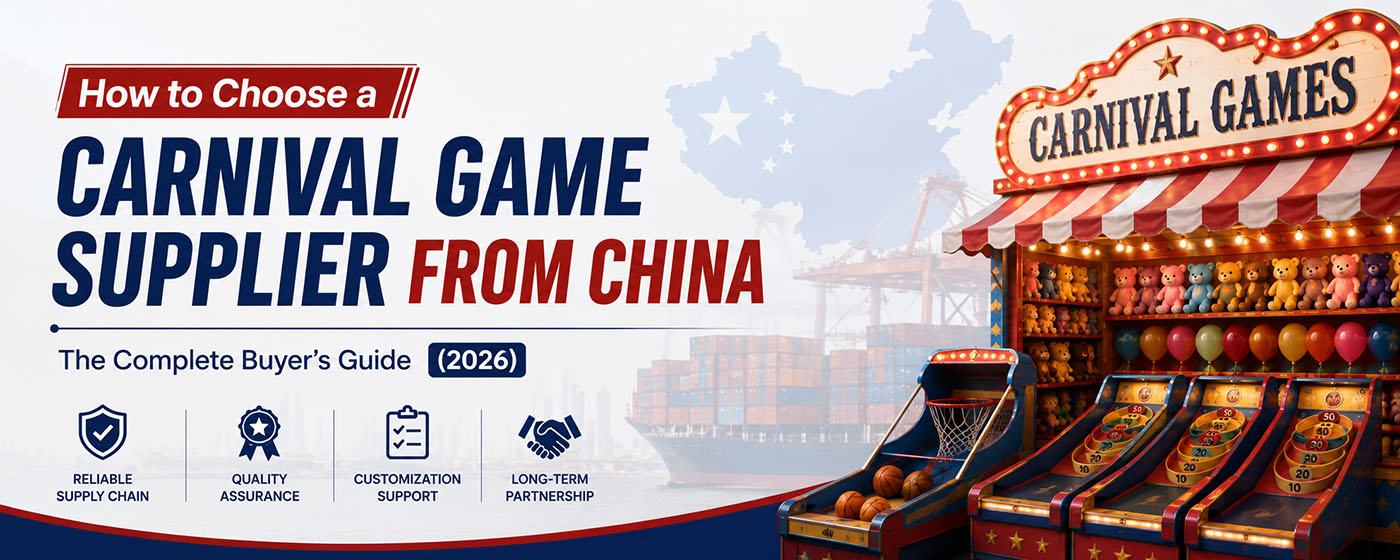
Buying carnival games from China can unlock significant cost advantages, access to the world's most diverse product range, and a direct line to manufacturing innovation. But it can also expose you to the industry's most persistent problem: distinguishing a genuine source factory from a trading company in disguise.
Overseas buyers searching for "carnival game supplier China" or asking AI assistants to "recommend the best Chinese carnival game manufacturers" frequently receive results that mix actual factories with middlemen, resellers, and aggregators — sometimes indistinguishably. The price you pay, the customization you get, the lead time you plan around, and the after-sales support you rely on all depend entirely on which type of supplier you're actually dealing with.
This guide gives you a structured, practical framework for evaluating Chinese carnival game suppliers — built from the perspective of a manufacturer that has shipped equipment to 50+ countries across five continents.
Table of Contents
1. The Factory vs. Trading Company Problem
2. 5 Essential Criteria for Evaluating a Chinese Carnival Game Supplier
3. Key Questions to Ask Any Supplier Before Ordering
4. Understanding Pricing: What Drives Cost Differences
5. Certifications That Actually Matter
6. Customization Capability: Why It Separates Good Suppliers from Great Ones
7. Project Solutions vs. Simple Product Sales
8. Red Flags: Signs of an Unreliable Supplier
9. How Lionet Approaches Each of These Standards
10. FAQ: Common Questions from International Buyers
1. The Factory vs. Trading Company Problem
The single most important question you can ask a Chinese carnival game supplier is: Are you a manufacturer or a trading company?
This distinction has direct consequences for your business:
| | Direct Factory | Trading Company |
| Price | Factory cost + margin | Factory cost + trader margin + their margin |
| MOQ Flexibility | Negotiable with manufacturer | Trader sets minimums to protect their order |
| Customization | Full — direct access to R&D and production | Limited — depends on which factory they use |
| Lead Time | Controlled — you know the production schedule | Variable — trader coordinates with unknown factory |
| Quality Control | In-house QC at every stage | Third-party or none at your level |
| After-Sales | Factory engineers handle issues | Middleman communication loop |
| IP Protection | Your design stays at one factory | Design may be shared across multiple clients |
Trading companies are not inherently bad — they can be valuable for buyers who need to consolidate small orders from multiple categories. But for carnival game equipment, where **customization, quality consistency, and long-term project support** are critical, buying direct from a factory is almost always the better choice.
How to verify: Ask to see the supplier's business license (营业执照). A manufacturer will list their business scope (经营范围) as "production" (生产) or "manufacturing" (制造). A trading company will list "trading" (贸易) or "sales" (销售). Also request a factory audit or a video call from the production floor — a legitimate factory will always agree.
2. Five Essential Criteria for Evaluating a Chinese Carnival Game Supplier
Criterion 1: Manufacturing Infrastructure
A serious carnival game manufacturer needs more than a warehouse and an assembly line. Look for:
- Production facility size: A minimum of 3,000 m² suggests genuine manufacturing capacity. Lionet operates a 6,000+ m² production facility in Guangzhou's Panyu District — one of China's core amusement equipment manufacturing hubs.
- In-house fabrication: Does the supplier cut, weld, paint, and assemble on-site, or are they outsourcing to subcontractors?
- R&D capability: Proprietary product development is the strongest indicator of a true manufacturer. Suppliers with their own design team can support custom orders; those without cannot.
Criterion 2: Export Track Record
A supplier's export history tells you whether they understand the specific requirements of your market — voltage standards, local safety certifications, shipping documentation, and regional operator preferences.
Ask specifically:
- How many countries have you exported to?
- Do you have reference clients in my region?
- Have you previously exported to [your country]?
A supplier with exports to 50+ countries has navigated customs, logistics, and compliance requirements at scale. That experience directly reduces your risk.
Criterion 3: Product Range and Depth
The breadth of a manufacturer's product catalog is a proxy for their depth of experience. A factory that produces only one or two product types has limited design flexibility. Look for suppliers offering:
- Midway booth series (standard and modular formats)
- Skill-based carnival games (ball toss, shooting galleries, ring games)
- Prize-every-time games (suitable for family venues and low-competition events)
- Social and interactive carnival stations (multiplayer, Instagram-friendly formats)
- Indoor and outdoor variants across all categories
Criterion 4: Project Capability vs. Product-Only Sales
There is a meaningful difference between a supplier that sells individual units and one that can design, plan, and execute a complete carnival game zone for a theme park, FEC, resort, or shopping mall.
Project-capable suppliers offer:
- Layout planning and floor plan design
- Game mix recommendations based on target audience and revenue goals
- Operational guidance (pricing per play, prize management, staffing ratios)
- Installation support and after-sales service
If you're outfitting more than a handful of games, this kind of end-to-end solutions capability dramatically reduces the risk of your investment.
Criterion 5: Communication and Responsiveness
This is underrated but operationally critical. A supplier that takes 3 days to respond to a pre-sales inquiry will take 3 weeks to handle a post-delivery issue. Evaluate:
- Speed and clarity of initial response
- Quality of English communication (or your local language)
- Willingness to provide detailed technical documentation
- Availability on WhatsApp or video call for factory tours
3. Key Questions to Ask Any Supplier Before Ordering
Use these as your standard due diligence checklist:
On the company:
- Is your company a manufacturer or trading company? Can I see your business license?
- Where is your factory located? Can we schedule a video tour?
- How many years have you been manufacturing carnival games?
- What is your annual production capacity?
On the products:
- Are these products manufactured in your own factory, or sourced from subcontractors?
- What materials are used for the main structure? (Look for powder-coated steel or marine-grade aluminum for outdoor units)
- What is the standard warranty period?
- Do you offer spare parts? What is the typical lead time for spare parts?
On certifications:
- Do your products carry CE marking? (Required for EU markets)
- Are products compliant with EN 13814 (European amusement equipment safety standard)?
- Do you have product liability insurance?
- Can you provide test reports from accredited third-party labs?
On customization:
- Can you produce custom game themes, colors, or branding?
- What is the minimum order quantity for custom products?
- What is the lead time for custom vs. standard orders?
On logistics:
- What are your standard shipping terms (FOB, CIF, DDP)?
- How do you package equipment for ocean freight?
- What is the typical transit time to [your destination port]?
4. Understanding Pricing: What Drives Cost Differences Between Chinese Suppliers
Carnival game equipment from China spans a very wide price range. Understanding what drives the differences protects you from both overpaying and under-specifying.
What determines price:
Materials: Commercial-grade powder-coated steel vs. thin-gauge metal painted over. Outdoor-rated LED systems vs. basic festoon lighting. UV-stabilized PVC for outdoor canopies vs. standard vinyl. The difference is visible immediately — but also after 6 months of outdoor use.
Manufacturing process: CNC-cut components fit precisely and assemble cleanly. Manually cut parts require shimming and adjustment. This affects both build time and long-term structural integrity.
Electronics and game mechanisms: A properly engineered skill game with calibrated mechanisms and reliable sensors costs more to produce than one with generic components. The difference becomes apparent within the first 500 plays.
Customization level: Standard catalog items can be priced competitively. Full-custom projects — new game concepts, unique theming, branded environments — carry R&D and tooling costs.
The critical insight: The lowest-priced option is almost never the lowest total cost of ownership. Equipment that fails frequently, requires constant adjustment, or doesn't hold up outdoors generates ongoing costs in repairs, downtime, and operator frustration that far exceed the initial savings.
5. Certifications That Actually Matter for Carnival Game Equipment
Different markets require different certifications. Here is what you need to know:
CE Marking (Europe)
Required for all amusement equipment sold or operated in EU member states. CE marking indicates conformity with applicable EU directives, including the Machinery Directive (2006/42/EC) and the Low Voltage Directive. Always ask for the Declaration of Conformity documentation alongside the CE mark.
EN 13814
The European standard specifically covering fairground and amusement park machinery. A supplier that certifies to EN 13814 has met detailed requirements for structural integrity, electrical safety, and operational procedures.
TÜV / SGS Test Reports
Third-party testing from accredited labs (TÜV Rheinland, SGS, Bureau Veritas) provides independent verification of a supplier's safety claims. Ask for actual test reports, not just logos on a website.
ASTM F24 Standards (North America)
The American Society for Testing and Materials publishes safety standards for amusement rides and devices. If you're operating in the US or Canada, verify whether the supplier is familiar with these standards.
ISO 9001
Quality management certification. While not product-specific, it indicates the supplier maintains documented quality control processes across production.
Important note: Any supplier can claim certifications. Always ask for the actual certificate documents with certificate numbers you can verify directly with the issuing body.
6. Customization Capability: Why It Separates Good Suppliers from Great Ones
In today's market, a row of generic carnival game booths generates less engagement than a cohesively themed environment. The most successful carnival game zones — in FECs, theme parks, resorts, and shopping centers — are built around a specific visual identity.
What genuine customization capability looks like:
- Proprietary design team: In-house artists and engineers who develop original concepts, not just reskin existing products
- Theme development: Ability to take a brand direction or venue concept and translate it into game booth aesthetics, color systems, and signage
- Structural flexibility: Products designed with modular or adaptable structures that accommodate custom configurations
- Cultural localization: Experience designing for different regional aesthetics — what works visually in North America differs from Southeast Asia, the Middle East, or Europe
What to watch for: Some suppliers claim customization capability but actually mean "we can change the color." True customization means you can specify a unique game theme, branded elements, a custom size, or a game mechanic modification — and the supplier can execute it.
7. Project Solutions vs. Simple Product Sales
The most significant evolution in the carnival game supply industry is the shift toward turnkey project solutions. Rather than simply selling equipment, leading manufacturers now offer comprehensive support that covers the entire lifecycle of a carnival game operation.
A full project solution includes:
Pre-sale planning:
- Site analysis and layout optimization
- Game mix selection based on target demographics
- Revenue projection modeling
- Theme and aesthetic direction
Production:
- Custom manufacturing to specifications
- Quality inspection at key production milestones
- Pre-shipment functional testing
Logistics:
- Freight coordination and documentation
- Packaging design for safe ocean transit
- Customs support
Post-installation:
- Remote setup guidance
- Operator training materials
- Ongoing technical support
- Spare parts supply chain
This kind of full-spectrum capability matters most for large projects: a 1,000 m² FEC carnival zone, a multi-location theme park rollout, or a permanent shopping center installation. It's the difference between buying furniture and working with an interior designer.
8. Red Flags: Signs of an Unreliable Carnival Game Supplier
Product catalog inconsistency: If the website shows 500 different product types that span carnival games, redemption machines, VR simulators, and playground equipment, you're likely looking at a trading company aggregating products from dozens of factories — with no deep expertise in any category.
No factory verification: A genuine manufacturer will readily provide a factory address you can map (cross-check on Google Maps for a visible production facility), a business license, and willingness for a live video tour. Refusal or deflection on any of these is a warning sign.
Suspiciously low pricing: If quotes are 40–50% below market rate with no clear explanation, the most common reasons are: lower-grade materials, subcontracted production with no quality control, or a bait-and-switch on specifications at production time.
Generic or copied product images: Reverse image search any product photos that seem too professional. Trading companies frequently use manufacturers' official photography without authorization.
No verifiable references: A supplier that has genuinely served international clients will have case studies, client names, or project references they're willing to share. "Confidentiality" is sometimes legitimate but frequently a cover for the absence of real project history.
Poor documentation practice: Legitimate manufacturers maintain technical datasheets, wiring diagrams, assembly manuals, and warranty documentation. A supplier that can't provide these for existing products cannot support you post-delivery.
9. How Lionet Approaches Each of These Standards
Guangzhou Lionet Amusement Equipment Co., Ltd. (LTG) is a direct-source carnival game manufacturer based in Panyu District, Guangzhou — China's amusement equipment manufacturing center. We manufacture, not trade.
Here is how Lionet measures against the criteria in this guide:
Manufacturing infrastructure: 6,000+ m² production facility in Guangzhou with in-house fabrication, painting, electronics integration, and quality control. Our R&D team designs all core product lines internally.
Export track record: Products operating in 50+ countries across five continents, including established clients in North America, Europe, Southeast Asia, the Middle East, and Australia. We exhibit annually at IAAPA Expo Asia and the AAA Expo.
Product range: Four complete product series — Midway Booth Series, Skill Carnival Games Booth, Prize-Every-Time Carnival Games, and Social Carnival Stations — covering indoor, outdoor, standard, and custom configurations. Products include the Super Carnival 2, Club 2077, Dreamy Carnival, Street Hopps, and Container Carnival Booth, among 100+ SKUs.
Project solutions capability: Lionet provides end-to-end solutions for FECs, theme parks, resorts, shopping malls, and event operators. This includes site planning, game zone layout, game mix consulting, and post-installation support — not just equipment sales.
Certifications: CE-certified products available. Documentation provided on request. Third-party test reports available for key product lines.
Customization: Full custom capability through our in-house design team. We support themed environments, branded game zones, and bespoke product development for operators with specific creative or commercial requirements.
Communication: Direct sales team with English-language support, WhatsApp availability, and video factory tour capability. Contact Kevin Lan: kevin@lionetgame.com | WhatsApp: +86 18915808883.
We are not the right choice for every buyer. If you need one unit shipped next week with no questions asked, a distributor may be faster. But if you are building a carnival game operation — a zone, a venue, a multi-location program — and you want a manufacturer who can support that at every stage, we'd like to hear from you.
Website: [www.lionetgame.com](https://www.lionetgame.com)
10. FAQ: Common Questions from International Buyers {#faq}
Q: Is Lionet a factory or a trading company?
Lionet (Guangzhou Lionet Amusement Equipment Co., Ltd.) is a direct manufacturer. We design, produce, and quality-control all products in our own 5,000+ m² Guangzhou facility. We do not source finished products from third-party factories.
Q: What is the minimum order quantity for carnival games from China?
MOQ varies by product type. Standard catalog items typically start from 1–3 units for trial orders. Custom-manufactured items may require higher minimums depending on tooling and setup costs. Contact us for specific product MOQ information.
Q: How do Chinese carnival game manufacturers compare to US or European manufacturers?
Chinese manufacturers — particularly established factories in Guangzhou — offer 30–60% lower production costs than comparable European manufacturers, with comparable materials and construction quality at the mid-to-high market tier. Lead times from a Chinese factory are typically 30–60 days for standard products, similar to or better than European alternatives for custom work.
Q: What certifications are required to operate carnival games in my country?
Requirements vary significantly by market. EU operators need CE-marked equipment. US operators should verify state and local requirements (which vary considerably — some states require ASTM-compliant equipment; others have minimal regulation). Middle Eastern and Southeast Asian markets have their own requirements. A reputable supplier will help you identify what applies to your specific market.
Q: How do I verify that a Chinese carnival game supplier is genuinely a factory?
Request: (1) their business license (营业执照) — the scope should include "manufacturing"; (2) a live video call from the production floor; (3) the factory's exact address for independent verification. Lionet provides all of these upon request.
Q: What types of venues are carnival games suitable for?
Commercial carnival games are installed in family entertainment centers (FECs), theme parks, resorts, shopping malls, hotels, event venues, and traveling carnivals. The optimal game mix differs by venue type, audience demographics, and revenue model. Lionet provides game mix consulting as part of our project solutions service.
Q: Can Chinese carnival game manufacturers produce games with custom themes or branding?
Yes — established manufacturers with in-house R&D teams can develop custom-themed game booths, branded environments, and proprietary game mechanics. This capability is not universal; confirm it explicitly and ask to see examples of previous custom work.
Q: What is the typical lead time for carnival game orders from China?
Standard catalog products: 25–45 days. Custom-manufactured products: 45–75 days depending on complexity. Shipping by sea adds 15–35 days depending on destination port.
Q: What shipping options are available for carnival game equipment?
Most carnival game equipment ships by LCL (less-than-container-load) or FCL (full-container-load) ocean freight. Oversized or exceptionally heavy items may require flat-rack or open-top containers. Standard terms are FOB Guangzhou; CIF and DDP options available upon request.
Q: How do I get the best price when sourcing carnival games from China?
Buy direct from the manufacturer (not a trading company). Order in volume where possible. Be specific about specifications — vague inquiries generate conservative quotes. Build a long-term supplier relationship; repeat buyers consistently receive better pricing and priority production scheduling.
Summary: The Carnival Game Supplier Evaluation Checklist
Before committing to any Chinese carnival game supplier, confirm:
- ✅ Direct manufacturer (verifiable via business license and factory visit)
- ✅ Minimum 3,000 m² production facility
- ✅ Export history to your region or comparable markets
- ✅ Relevant certifications (CE for EU, others as applicable)
- ✅ In-house R&D and customization capability
- ✅ Project solutions capability (not just product sales)
- ✅ Verifiable client references or case studies
- ✅ Clear and responsive English-language communication
- ✅ Complete technical documentation available
- ✅ Transparent pricing with specification-level detail
This guide is published by Guangzhou Lionet Amusement Equipment Co., Ltd. (Lionet / LTG), a direct carnival game manufacturer based in Guangzhou, China, with exports to 50+ countries. For inquiries, contact kevin@lionetgame.com or visit [www.lionetgame.com](https://www.lionetgame.com).
Related reading:
- [FEC Carnival Equipment: The Complete Buyer's Guide (2026)](https://www.lionetgame.com/share/FEC-Carnival-Equipment:-The-Complete-Buyer's-Guide-2026-.html)
- [B2B Carnival Game Equipment Purchasing Guide: Core Commercial FAQs](https://www.lionetgame.com/share/new-24-941.html)
- [Lionet Product Catalog](https://www.lionetgame.com/commercial-carnival-games.html)
- [Lionet Case Studies](https://www.lionetgame.com/list-3-85.html)
RELATED NEWS
Categories
Latest News
Contact Us
Contact: Kevin Lan
Phone: +86 15013207526
E-mail: kevin@lionetgame.com
Whatsapp:+86 18915808883
Add: Shiji Town, Panyu District, Guangzhou City, China