 Leaderboards make guests play again because they turn a single round into a challenge. A visible score gives players a target to beat, a friend to compete with and a reason to say "one more go." For competitive socialising venues, connected leaderboards also link separate games into one shared experience. This guide explains how they work, which types to consider and how to avoid common mistakes.
Key takeaways
- A score only guests can see on their own machine is a game. A score friends can beat is a reason to stay.
- Different leaderboard types suit different venues: daily boards, team boards and venue-wide boards each do a different job.
- Leaderboards work best when they are visible, fair to newcomers and consistent across games.
- Operators should track repeat plays after launch, because results vary by venue.
What is a leaderboard in a competitive socialising venue?
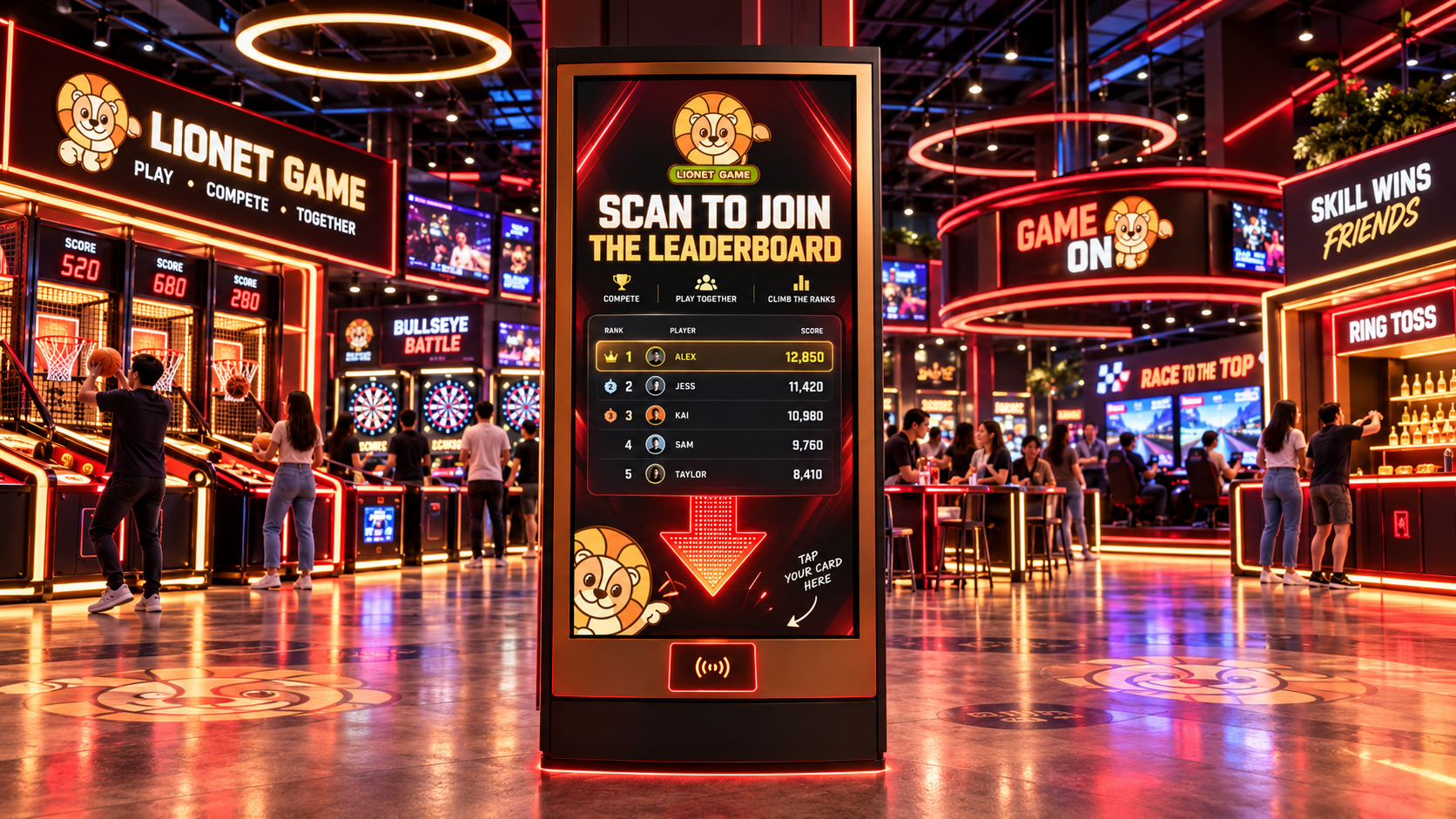
A leaderboard is a ranked display of guest scores, shown on or near the game, on a central screen, or both. In a competitive socialising venue, leaderboards usually do more than rank one game. When games are connected, scores can feed into a venue-wide ranking, so guests compare themselves across the whole experience rather than machine by machine.
This is the difference between a row of carnival games and a competitive attraction. The games may be simple, but the competition around them gives guests a reason to stay longer and return.
Why leaderboards make guests play again
1. They give guests a clear target
"Beat 1,200 points" is easier to act on than "have a good go." A visible number turns a casual round into a goal.
2. They make the competition personal
Guests rarely care about a stranger's score. They care about a friend's, a colleague's or a rival group's. Leaderboards give them someone to challenge, which is what drives "rematch" behaviour.
3. They create a reason to come back
Daily, weekly or event-based boards give guests a fresh chance to climb. A guest who finished fifth today has a reason to return tomorrow.
4. They make the venue feel like one experience
When scores are consistent across games, guests move from one game to the next to improve their overall standing. Connected gameplay is what makes this possible, and it is a core idea behind Lionet's Social Competition Carnival Games.
Types of leaderboards and when to use them
| Leaderboard type | Best for | Watch out for |
|---|---|---|
| Per-game | Giving each game its own challenge and bragging rights | Guests may not see how games relate to each other |
| Venue-wide | Linking games into one experience and encouraging guests to try more of them | Needs consistent scoring across games |
| Daily or weekly | Giving newcomers a fair chance and encouraging return visits | Resetting too often can feel pointless |
| All-time | Showcasing record scores and building venue legends | Can discourage newcomers if records are out of reach |
| Team or group | Parties, corporate events and group bookings | Needs a simple way to register teams |
How to design leaderboards that work
- Make them visible. A leaderboard nobody sees does nothing. Place displays where guests and bystanders can read them easily.
- Keep scoring easy to understand. If guests cannot tell why they scored what they did, they will not trust the ranking.
- Be fair to newcomers. Daily or weekly boards, alongside all-time records, give first-time guests a realistic chance to appear.
- Keep sign-up light. Every extra step before a round reduces play. Nicknames or simple entry usually work better than long forms.
- Use the same scoring logic across games. This is what makes a venue-wide ranking meaningful.
- Pair scores with replays. Action replays give guests a moment worth sharing, which brings the venue to people who were not there.
If you collect names or contact details for leaderboards, check the data protection rules that apply in your market.
Common leaderboard mistakes
- Hidden displays. Scores shown only on the machine miss the social part of competition.
- Never resetting. If records are impossible to beat, most guests stop trying.
- Inconsistent scoring. If each game uses a different logic, a venue-wide ranking has little meaning.
- Too much friction. Long registration before a round drives guests away.
- No follow-up. A leaderboard works harder with events, challenges or recognition for top players.
What to ask when choosing carnival games with leaderboards
Before buying, operators can ask a manufacturer:
- Are scores connected across games, or does each game work on its own?
- Can leaderboards be shown on a central screen as well as on the game?
- Can rankings be reset daily, weekly or for events?
- Are action replays available, and how are they displayed or shared?
- Can game mechanics be tailored to our venue and audience?
- Can we start with a few games and add more later?
For a broader planning framework, read our guide on how to start a competitive socialising venue.
Frequently asked questions
What is a leaderboard in a carnival game?
A leaderboard is a ranked display of player scores. In competitive socialising venues, connected leaderboards can combine scores across games so guests compare themselves across the whole venue.
Do leaderboards make guests play more?
Leaderboards give guests a clear target and someone to beat, which encourages replay. Results vary by venue, so operators should track repeat plays after launch.
Should leaderboards be per game or venue-wide?
Both can work. Per-game boards give each game its own challenge, while venue-wide boards link games into one experience. Venue-wide boards need consistent scoring across games.
How often should leaderboards reset?
Daily or weekly boards give newcomers a fair chance, while all-time boards showcase records. Many venues combine both so guests always have a reachable goal.
Do leaderboards need staff to run?
Automated scoring and connected leaderboards are designed to reduce manual work, though exact staffing depends on your venue and service model.
Plan your leaderboard-driven venue with Lionet
Tell us your space, audience and game requirements, and the Lionet team will suggest a game mix and a budget framework.
On the inquiry form, choose "venue solution" and include your venue type, floor area, country and target opening date. We usually reply within one business day.