A commercial carnival games supplier should help you select equipment that fits the events you can sell and deliver consistently. Repeat bookings depend on the complete experience: suitable challenges, clear rules, manageable queues, reliable operation and a useful reason for the client to book again.
This guide is for event rental companies, recurring festival organizers and family entertainment centers building party or group-event programs. It explains how to connect game selection with the package you offer, the resources needed to deliver it and the feedback that guides future purchases.
Lionet designs and manufactures original carnival games for entertainment venues, operators and distributors. Its range gives buyers several formats to discuss, while its venue solutions and ODM capabilities support project-specific development. The examples below use published product specifications alongside practical planning methods.
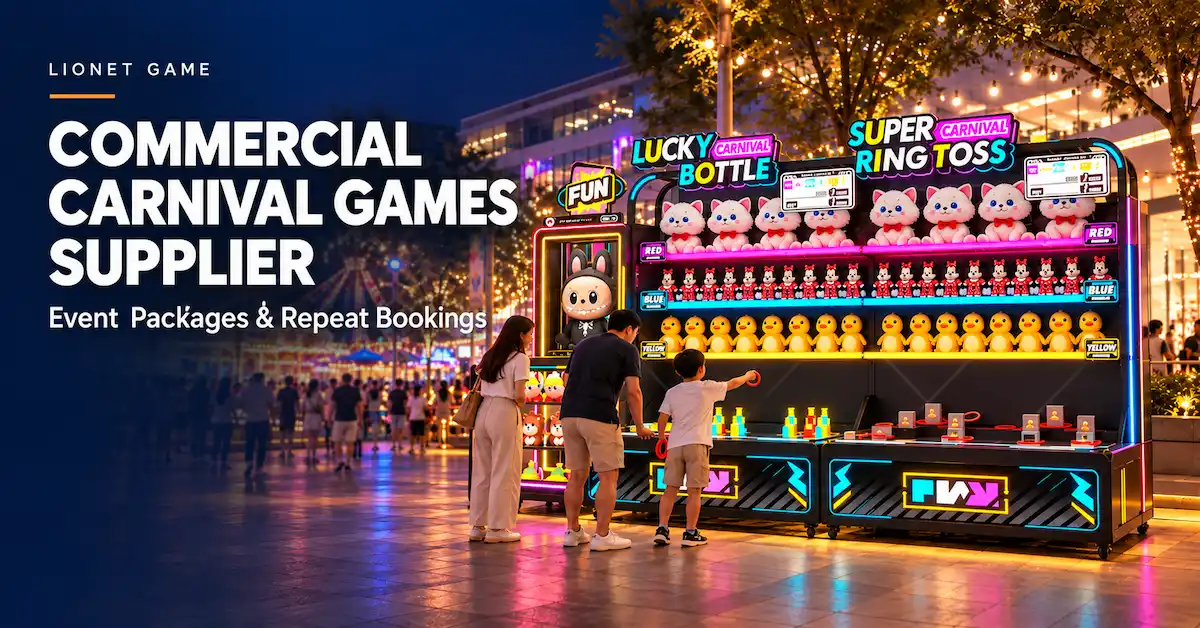
Why clients book a carnival game experience again
A client usually buys an outcome: guests taking part, families spending time together, employees interacting or a festival zone running smoothly. The equipment matters because it makes those outcomes easier to deliver. A familiar carnival format can lower the effort needed to explain the activity, while different challenges give guests reasons to move through the zone.
Make the first attempt easy to understand
New players need to see what to do, where to stand and how their attempt ends. A demonstration that takes less time than a lengthy explanation can keep participation moving. Before selecting a game, watch an unfamiliar player try it without coaching. Note every point where the person hesitates or asks a question.
For family events, check reach, sight lines and the intended age range with the supplier. A challenge that entertains adults may need a different configuration or a separate option for younger guests. Do not assume that a colorful cabinet makes a game suitable for every child.
Give returning guests a different experience
Repeat participation can come from improving a score, trying another challenge or playing with a new group. These are different reasons to return. Choose complementary activities rather than several stations that all ask players to perform the same action.
A recurring corporate event might change its team format between bookings. An FEC birthday package might change the order of challenges or the approved prize assortment. Keep the rules consistent within each event so that a refreshed experience still feels fair and understandable.
Make the organizer's job easier
The decision-maker also remembers delivery quality. Was the zone ready on time? Did staff know the rules? Were queues contained? Did the invoice match the agreed scope? These details affect the next purchasing decision even when guests enjoyed the games.
Match the game mix to the event you want to sell
Start with the client group and event format. A drop-in shopping mall activation has different participation patterns from a scheduled birthday party. A school fundraiser may receive a short rush of guests, while a corporate gathering may need an organized group rotation.
Lionet's carnival games for events solutions cover festivals, seasonal events, brand activations and temporary entertainment spaces. The same Solutions page also describes carnival games for FECs. Use these applications to frame your brief, then explain the operating conditions of your particular site.
| Event or program | Guest experience to prioritize | Planning question |
|---|---|---|
| Family party or FEC birthday | Approachable activities and a manageable group rotation. | Can the intended age group participate, and how long will the party spend in the zone? |
| Corporate gathering | Visible competition and clear team participation. | How will teams rotate without keeping most participants waiting? |
| Festival or community event | Simple entry, short explanations and contained queues. | What happens when several groups arrive at the same time? |
| Brand activation | A coherent theme and an identifiable interaction. | What artwork, prize policy and reporting does the client expect? |
Write down the expected guest number, event duration and busiest arrival period. Add whether participation is included in admission, sold per play or bundled into a package. These choices influence the game cycle, staffing, payment handling and prize distribution.
A commercial carnival games supplier can respond more accurately when those conditions are known. Instead of asking only for a catalog and price list, ask which configuration matches your brief and which assumptions still need a site review or demonstration.
Select commercial games by their role in the package
Review commercial midway games as parts of an experience. Each attraction should have a clear purpose: welcoming first-time players, providing a replayable challenge, serving groups or creating a visible focal point. That purpose helps you decide whether the next purchase adds useful variety.
01 · COMPACT STATION
X-Carnival
Evaluate compact carnival games when cabinet size is a major constraint. Confirm the space needed for the player, queue and service access as well as the cabinet itself.
02 · COMBINED CHALLENGES
Double Fun Carnival
Double Fun Carnival combines two to four game options. Discuss the exact modules and how each fits the experience you want to offer.
03 · GROUP FOCAL POINT
Dreamy Carnival
For multiplayer carnival games, examine how players enter, leave and move around the attraction. Full-circle access requires a complete circulation plan.
| Specification | X-Carnival | Double Fun Carnival | Dreamy Carnival |
|---|---|---|---|
| Dimensions W × D × H | 1,100 × 900 × 1,950 mm | 4,830 × 3,050 × 2,680 mm | 5,437 × 5,437 × 3,268 mm |
| Listed player capacity | 1 | 4 | 6 |
| Listed power | 330 W | 1,400 W | 3,300 W |
| Listed weight | 180 kg | 760 kg | 1,200 kg |
| Listed environment | Indoor | Indoor | Indoor |
| Described game options | 11 games | 2–4 games in one attraction | 6+ interchangeable combinations |
Reference data comes from the linked Lionet product pages. Player customization is stated on those pages; game count and player capacity describe different things. Dimensions and weight require project-specific handling and installation review.
Separate a compact cabinet from a mobile rental system
A smaller attraction can still be heavy or need specialist handling. For example, the published width and depth of X-Carnival calculate to a 0.99 m² cabinet envelope. That figure excludes a player's position, queuing and maintenance access, and it does not establish suitability for frequent transport.
For a touring event business, request packed dimensions, lifting points, transport protection and the assembly sequence before ordering. For a fixed FEC party zone, focus on layout, group supervision and changeover between booked sessions. The two applications need different approval checks.
Plan queues, game cycles and staffing before launch
Player capacity describes how many positions a configuration lists. Throughput describes how many completed sessions the operating system can deliver over time. Instructions, payment, play, result handling and resetting all affect that system. A six-player attraction does not automatically process six new players every minute.
Run a timed demonstration using the intended rules and an unfamiliar group. Include the activities staff perform between turns. Observe how the experience changes when a player needs help, a prize needs replenishing or a group arrives before the previous session ends.
Planning estimate
Completed player sessions per hour = active positions × 60 ÷ average complete cycle in minutes × operating utilization.
For illustration only, four independent positions with a three-minute complete cycle have a theoretical capacity of 80 player sessions per hour. Applying an assumed 70% utilization gives 56 sessions. This is a planning example, not a Lionet performance claim. If players start together, share a reset or use a common attendant, the assumptions must change.
Design the space around the complete activity
Mark the cabinet, active play area, player standing position, queue, spectators and service access on the plan. Show where guests enter and where they leave. Check whether a popular station blocks another attraction or interrupts the main route through the venue.
For a group program, put the next waiting team somewhere staff can supervise without interfering with play. For an open-entry event, distinguish the queue from people watching. Your supplier's equipment drawing should be combined with the venue's access and circulation requirements.
Assign responsibilities rather than guessing a staff number
List who explains the rules, handles payment, supervises play, resets equipment and distributes prizes. Combine duties only after testing the workload. A self-contained-looking cabinet can still require attendance under the venue's operating rules or the chosen game format.
Ask your commercial carnival games supplier to demonstrate routine operator tasks and service access. Build a short staff briefing around the approved configuration. New staff should understand when to stop play, who resolves a fault and how to keep a waiting group informed.
Calculate event contribution and the cost of repeat deployment
Equipment purchase price is only one part of the business case. An event package also consumes delivery time, labor, prizes, storage, maintenance and coordination. A package that sells frequently can still underperform if each booking needs unplanned staff or a difficult transport process.
Use a contribution calculation for each event, then compare it with your fixed operating costs and investment. Keep tax treatment and accounting assumptions consistent. Your local finance team can help decide how to allocate shared overhead and depreciation across different packages.
Event contribution
Event revenue − event-specific labor − transport − prizes − consumables − other direct event costs.
Suppose a package generates $1,200 in event revenue. Illustrative direct costs of $250 labor, $180 transport, $120 prizes and $50 consumables leave $600 contribution. That is not $600 net profit: equipment recovery, storage, insurance, selling costs, administration and other overhead remain to be covered. These figures are hypothetical and do not represent Lionet pricing or customer results.
| Cost area | What to capture | Improvement to test |
|---|---|---|
| Delivery and handling | Vehicle, loading crew, access delays and return journey. | Better route planning and a verified loading procedure. |
| Event labor | Preparation, assembly, operation, breaks and pack-down. | Clearer roles and a documented changeover process. |
| Prizes and consumables | Actual issue quantity, landed cost and damage. | An approved reward policy and tracked replenishment. |
| Wear and downtime | Repair time, parts used and missed sessions. | Pre-event checks and a suitable spare-parts plan. |
| Storage and investment | Space, protection, financing and asset recovery. | A booking forecast with conservative utilization assumptions. |
Control prize costs without confusing players
Decide whether the event uses a skill-based reward, participation prize or another approved policy. Explain that policy clearly before play. Calculate expected prize cost from the actual reward rules and landed prize prices, rather than assuming every station has the same cost per participant.
Measure stock before and after the event. If the cost differs from the estimate, check the mix of prizes, issue rules and staff practice. Changes to scoring, difficulty or rewards should follow the approved game configuration and applicable local requirements.
Build event packages clients can book again
A recurring event program needs a clear reason for the client to return. That reason may be a familiar family activity, a different challenge for the next celebration, or an entertainment package that is straightforward to organize. Start by defining what the client is buying: the equipment configuration, operating period, staffing responsibilities, prize allowance, and guest experience.
For an event rental company, the package must also describe delivery, site access, setup, collection, and any restrictions. For an FEC hosting parties, clarify how the carnival session connects with check-in, food service, other attractions, and the reserved party area. These details influence whether the experience feels coordinated, regardless of how attractive the equipment looks.
Keep the core repeatable; make the occasion distinctive. Preserve the approved operating procedure and selected equipment while changing elements that have been agreed as feasible: the event theme, group challenge, prize selection, or session format. Confirm every requested change before advertising it.
Use the following package structure as a planning template. These are example commercial offers, not preset Lionet packages or promises about a particular product.
| Package | Reason to return | Define before selling |
|---|---|---|
| Family party session | A shared activity for another birthday or celebration | Guest count, allocated time, host role, and prize policy |
| Corporate team challenge | A different group format for the next company gathering | Team rotation, scoring rules, participation method, and reset time |
| Seasonal carnival program | A new occasion with familiar, understandable gameplay | Approved theme changes, game mix, operating dates, and storage plan |
Choose carnival games for events according to that operating brief. A compact station, a multi-game booth, and a larger circular attraction require different layouts and handling arrangements. A package suitable for a permanent FEC party zone may be unsuitable for a venue that provides only a short access window.
Pilot the package before expanding it
Publish a concise package specification with the agreed inclusions and exclusions. Keep the event brief and approved operating procedure together, so the next booking can repeat what worked without relying on the memory of one team member.
Before expanding the program, run a pilot with the proposed staff and timetable. Observe arrival, instructions, participation, prize handling, reset, and departure. Adjust the package where guests wait without a clear next step or the team cannot prepare the next group comfortably. Keep that revised procedure available for the next event.
Measure rebooking with a three-step review
Guest participation and client rebooking answer different questions. Participation shows whether people used the activity; rebooking shows whether the purchasing client returned for another occasion. Record both so a busy game area does not become your only measure of commercial success.
- Record delivery and participation. Note scheduled and actual setup time, staffing hours, completed sessions, queue observations, interruptions, and prize use. Use the same definitions across comparable events. Record the venue and package configuration so differences can be explained.
- Ask the client about the next decision. Collect feedback on organization, guest suitability, communication, and the package scope. Ask which upcoming occasion could use a similar program and what would need to change. A favorable review is useful feedback; it is not a confirmed future booking.
- Track confirmed return business. Separate inquiries, quotations, and paid repeat bookings. Compare clients who had a realistic opportunity to book again during the same observation period. Review the contribution remaining after event-specific costs alongside the return rate, then decide which packages to retain, revise, or stop.
Bring those observations to the next equipment discussion. They help you choose between adding capacity, improving the game mix, changing the session schedule, or simplifying operation before committing to another attraction.
Work with a commercial carnival games supplier on customization
Theming helps a package feel connected to a client's event, but it needs a practical scope. Distinguish approved artwork changes from modifications to structure, game mechanics or controls. The development time, validation and future maintenance implications can be very different.
Lionet's custom carnival games capabilities include ODM work from concepts and gameplay through prototyping, testing and production. Begin with a brief explaining the audience, commercial use, theme and operating constraints. Ask which parts of the proposed configuration can be customized and which require new development.
Prepare approvals that can be reused
For a recurring corporate program, define artwork ownership, approved colors and the sign-off process before production. For a seasonal event series, confirm whether graphic changes can be made without altering the validated structure. Keep final files and configuration records so a later order refers to the same approved version.
Request a written change list, a sample or prototype review where appropriate, and a revised commercial scope. Do not schedule launch around an assumed development period. Align artwork approval, production, packing, shipping and site readiness against the actual event date.
Before buying from a commercial carnival games supplier, agree on acceptance evidence. Useful items include a gameplay demonstration, a dimensional check, a configuration list, power requirements and operating documentation. Ask for the product-specific records relevant to your destination market; a general factory claim does not establish compliance for every ordered model.
What to send a commercial carnival games supplier
A useful inquiry lets the supplier evaluate fit before quoting. Describe the events you sell most often and the conditions that are fixed. If you operate several venues, explain the common requirements and the differences. This helps separate a standard configuration from work that needs customization.
- Business model: fixed FEC parties, touring rentals, recurring festivals or branded activations.
- Audience and schedule: intended ages, guest numbers, event duration and peak arrivals.
- Site: usable floor plan, ceiling height, entrances, loading route and operating environment.
- Operation: participation rules, payment method, prize policy and available staff.
- Equipment: preferred formats, quantities, customization and handling requirements.
- Commercial brief: destination market, budget range, target date and requested service scope.
Ask the response to identify recommended games, the proposed configuration, outstanding technical questions and an itemized quotation. Confirm packaging, shipping responsibilities, assembly guidance, training, spare parts and after-sales arrangements. Compare quotations using the same scope so a missing service does not look like a lower total cost.
For the opening event, make a readiness checklist covering equipment receipt, site access, power, staff briefing and a complete test session. Agree who approves each item and what happens if a dependency is late. A clear handover supports consistent operation after the supplier's delivery is complete.
FAQ: commercial carnival games for repeat event programs
How do I choose a commercial carnival games supplier for events?
Begin with the events you intend to serve, then compare product fit, complete operating requirements and delivery scope. Request a demonstration, configuration records and handling information for the actual models. Include maintenance and parts support in the comparison.
Can carnival games guarantee more repeat bookings?
No equipment selection guarantees repeat bookings. Rebooking depends on audience fit, event delivery, client budget, satisfaction and follow-up. Track those results and refine the package before expanding your inventory.
Are compact games automatically suitable for mobile rentals?
No. Cabinet size does not establish ease of loading or repeated transport. Verify weight, packed dimensions, handling requirements, assembly and transport protection. Evaluate your vehicle, crew and site access against that information.
How many games should an event package contain?
Use the required experience and expected demand to decide. A smaller complementary mix can be more useful than several similar challenges. Time complete game cycles and test whether the mix serves guests within the event window.
Can Lionet games be used at outdoor festivals?
The reference product specifications in this guide list indoor use. Send the site conditions and exposure details to Lionet for a configuration-specific assessment. A festival application description does not establish weather resistance for every model.
What should I send when requesting customization?
Provide the theme, audience, venue plan, artwork requirements, game concept, quantities and target date. Separate branding changes from structural or gameplay development. Ask for an approval sequence and quotation covering the agreed work.
How much does a commercial carnival games supplier charge?
Pricing depends on the model, quantity, game configuration, development work and delivery scope. Request an itemized quotation rather than relying on a general price range. Include the costs required to prepare the site, operate the event and support the equipment.
How far ahead should I request a proposal?
Share the target event date early and ask for a schedule covering approvals, production, packing, freight and site preparation. Custom development may require additional prototype and test stages. Confirm the actual lead time for your project before selling the opening event.
Conclusion
Choose a commercial carnival games supplier around the event package you can deliver consistently. Prioritize complementary play, a workable layout, realistic capacity and a clear cost model. Use feedback and booking results to decide what to refresh or expand.
Share your audience, floor plan, operating model and target date with Lionet to discuss a suitable game mix and quotation scope. A specific project brief is the best starting point for a useful proposal.