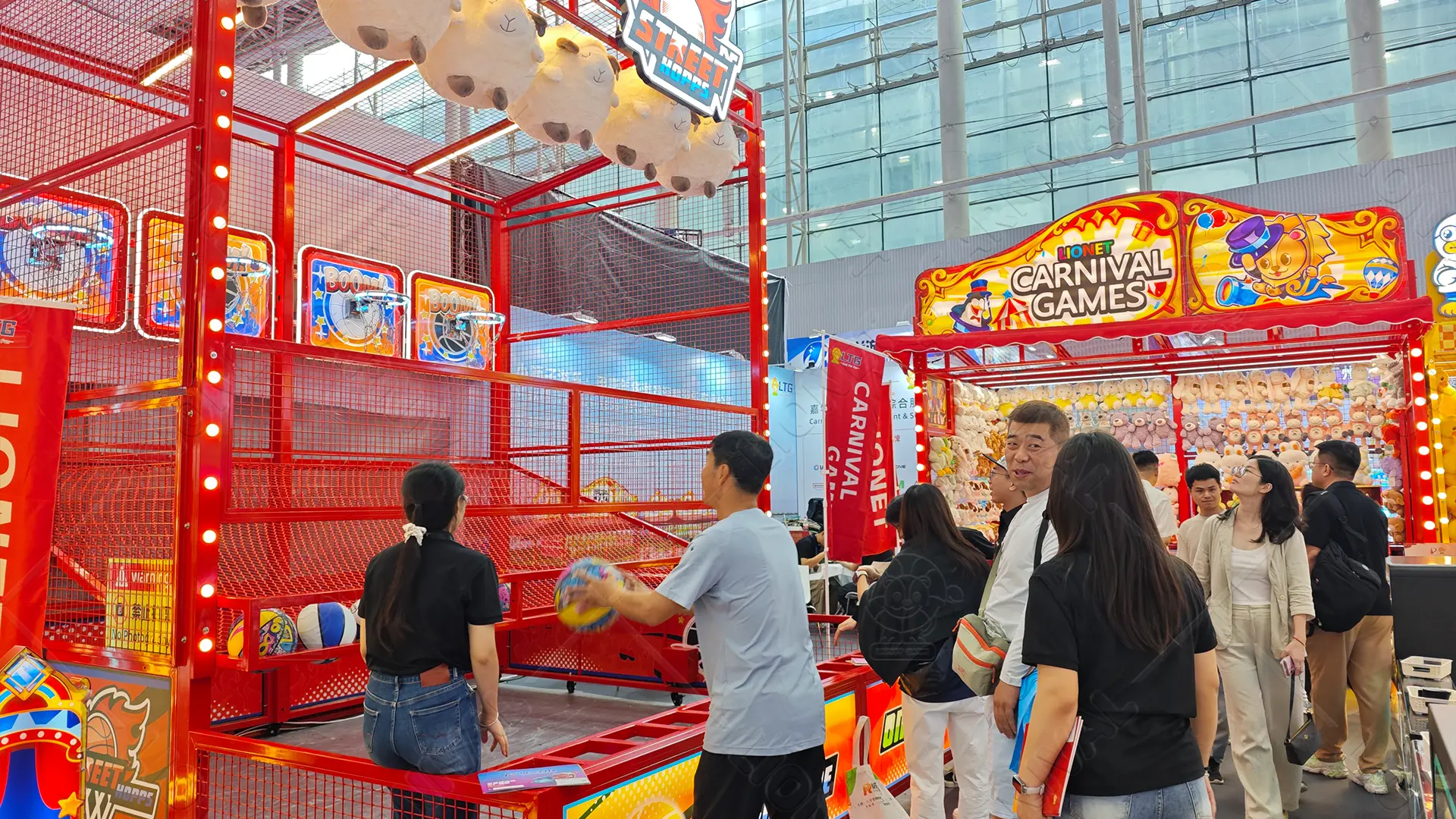
Quick answer: LIONET Street Hoops is an outdoor basketball carnival game designed for four players at the same time. The published “One In Wins” rule recognizes a successful basket with sound and flashing lights, while balls return automatically to a collection area. The equipment measures 4,140 × 4,244 × 5,119 mm, weighs 900 kg, and lists 900 W power. For commercial buyers, the priorities are player flow, prize handling, delivery access, overhead space, and confirmation of the exact operating configuration.
Why Street Hoops Is More Than a Basketball Toss Stall
Commercial carnival games need to communicate a challenge quickly. Visitors should understand what to do, what counts as a successful attempt, and where to go when their round ends. With Street Hoops, the basic action is instantly recognizable: players shoot basketballs toward a hoop. The difference is the combination of four simultaneous playing positions, a clearly stated win rule, automatic ball return, and audible and visible success feedback.
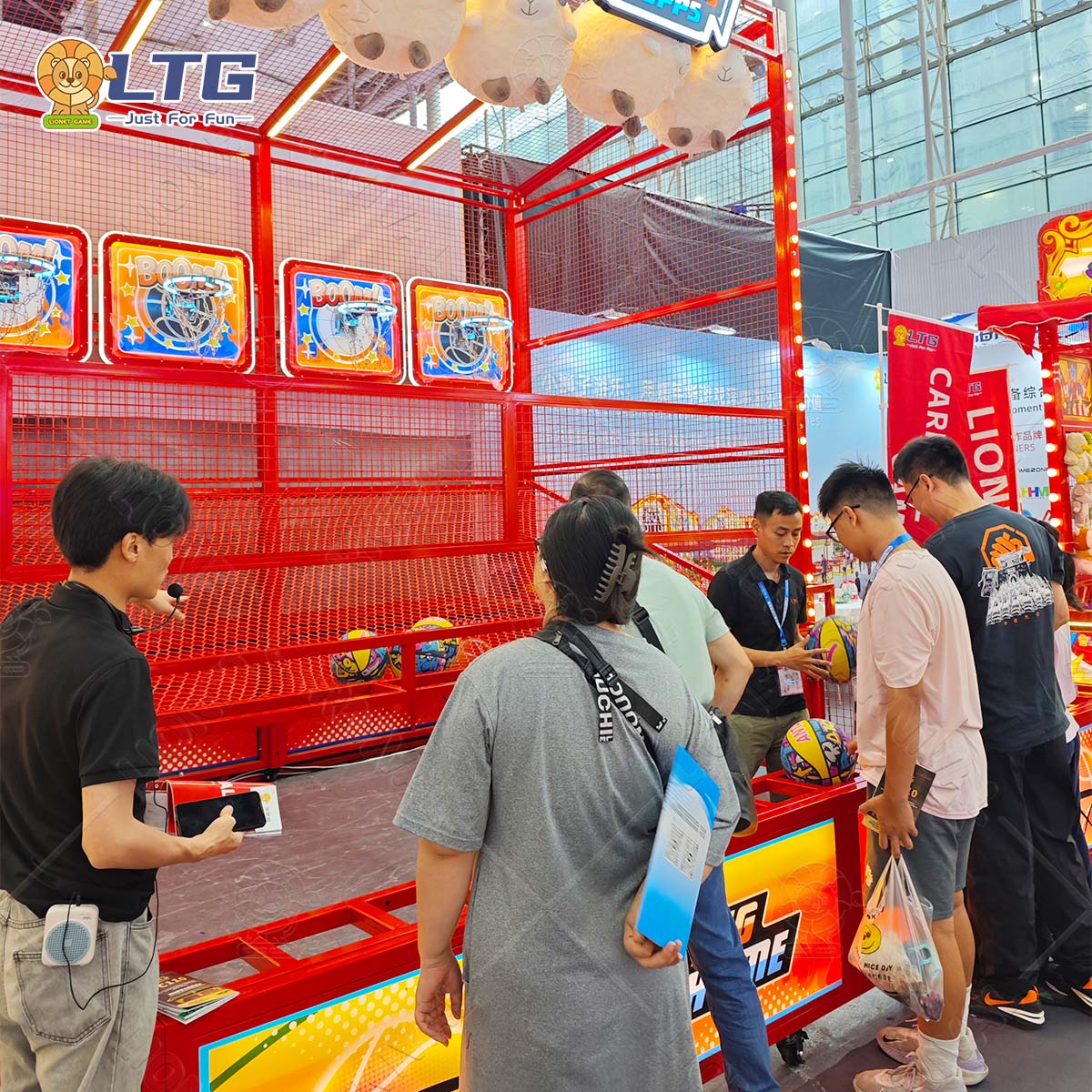
According to its official product listing, LIONET describes the basket height as close to international-standard hoop height. This is the manufacturer's product description, not a published exact rim-height measurement or a claim that the equipment meets a competition rulebook. For installation and game difficulty decisions, request the actual rim and shooting-position drawings.
The product is intended for outdoor entertainment venues such as amusement parks, resort attraction areas, cultural and tourism sites, and large outdoor parks. That positioning makes Street Hoops a different purchasing decision from a small indoor basketball arcade cabinet. Its height, outdoor handling needs, prize process, and surrounding guest movement should all be assessed before purchase.
How the Four-Player “One In Wins” Experience Works
The published game rule is “One In Wins”: a made basket counts as a win. On a successful shot, Street Hoops provides a sound alert and flashing lights. The balls then return automatically to a collection area, reducing the need to retrieve each ball manually. The supplier also describes an operating arrangement with one attendant supervising gameplay and distributing prizes.
These are useful product features, but they do not settle every venue's operational details. The public listing does not identify a universal ticketing interface, a specific award schedule, a fixed game-round duration, or automatic prize dispensing. Operators should confirm the complete play sequence and the prize policy for the configuration they buy.
| Stage | Published feature or intended action | What the operator should verify |
|---|---|---|
| Join | Four people can shoot at the same time | Starting positions, queue arrangement, guest instructions |
| Attempt | Players shoot basketballs toward the hoops | Round length, available balls, reset sequence |
| Successful basket | “One In Wins” and sound/light feedback | How a win is registered and how prizes are awarded |
| Ball collection | Automatic return to a collection area | Return path, ball pickup, inspection and cleaning |
| Finish | Attendant-supervised prize distribution | Prize stock, recordkeeping and next-player handover |
For a high-traffic outdoor attraction, that sequence is more useful to plan than an assumed number of players per hour. Four playing positions are published; hourly throughput is not. Real results depend on the selected round rules, prize handling, queue behavior, staffing, and site conditions.
Street Hoops Technical Specifications: What the Published Figures Mean
The table below distinguishes what LIONET publishes for the model from the questions buyers should resolve before approving transport, site installation, or a quotation. Treat every measurement as a published product reference, not a substitute for the final ordered-unit drawing.
| Item | Published specification | Buying implication |
|---|---|---|
| Product | Street Hoops | Identify the exact model and configuration |
| Brand | LIONET | Original carnival game designer and manufacturer in China |
| Primary use | Outdoor basketball carnival attraction | Check suitability for the intended outdoor site |
| Players | 4 simultaneous players | Plan four play positions and waiting space |
| Dimensions (W × D × H) | 4,140 × 4,244 × 5,119 mm | Check equipment footprint, height and overhead clearance |
| Weight | 900 kg | Review unloading, ground conditions and moving procedure |
| Power | 900 W | Confirm supply voltage, frequency, connection and cable route |
| Materials | Acrylic and metal | Request final component, care and finish details |
| Game rule | “One In Wins” | Confirm the round and prize-distribution procedure |
| Result feedback | Sound alert and flashing lights | Review operation and settings for the venue |
| Ball return | Automatic return to collection area | Observe a complete real-game demonstration |
| Operator arrangement | 1 attendant listed for supervision and prizes | Confirm actual staffing needs for the site |
| Mobility | Caster wheels | Plan the move with the 900 kg mass in mind |
| Outdoor feature | Rain protection described by manufacturer | Confirm operating and storage conditions; no IP rating is stated |
| Published MOQ | 1 unit | Ask for current price, packaging and delivery scope |
Important: The 4,140 × 4,244 mm equipment base is not the total space needed for a working carnival game. It does not include the approach path, queues, spectators, service movement, or the handling area for installation. Likewise, 5,119 mm is the listed equipment height, not a confirmed minimum safe overhead clearance. Ask for dimensioned drawings before committing to a venue location.
Design Five Zones Around Four Active Basketball Players
For an outdoor basketball carnival game, a workable layout starts with people rather than equipment photos. The positions below are planning categories. They are not manufacturer-published clearance measurements or universal minimum distances.
1. The equipment and overhead zone
Mark the complete 4,140 × 4,244 mm footprint on the venue drawing and flag the 5,119 mm overall height. Check nearby trees, decorative structures, temporary overhead lighting and adjacent attractions. Ask for the final installation drawing and any handling or assembly allowances that are not shown in the public dimensions.
2. Four player starting positions
Identify where four participants stand during a round. The precise throwing position, shooting distance, and ball supply arrangement should come from the selected product setup rather than being guessed from the outer equipment size. Make the game instructions visible at the point where participants join.
3. Queue and spectator areas
A basketball challenge naturally invites friends to watch. Give waiting guests a clear place outside the active shooting area, and separate observers from guests moving between attractions. For a busy amusement park path, think about how an approaching group will understand the queue before it reaches the game.
4. Attendant and prize-service access
The manufacturer's published arrangement identifies one attendant for supervision and prize distribution. Preserve a place for the operator to explain rounds, observe successful baskets, collect or provide balls as needed, and manage prizes. Confirm how that position works when all four players are active and whether the site requires additional support.
5. Ball return, power and delivery routes
Keep the ball collection area accessible to the operating team. Place the power supply where site staff can route cables appropriately, based on the final electrical specification. Separately plan how the 900 kg game is unloaded and moved on casters to its operating position; caster wheels are not a guarantee that every ground surface or slope is suitable.
| Zone | Site-planning question |
|---|---|
| Structure | Can the full equipment height and base be accommodated? |
| Players | Are all four positions clear and easy to understand? |
| Queue | Can visitors wait without blocking adjacent outdoor attractions? |
| Operator | Can staff supervise shots and distribute prizes without crossing active players? |
| Service | Are ball collection, power supply, unloading and maintenance routes workable? |
Prize Flow: Make “One In Wins” Easy to Run and Explain
The winning moment is the feature visitors remember, but it is also a decision the operator needs to document. Street Hoops uses the supplier's stated “One In Wins” format, meaning a made basket counts as a win. Before launch, agree how the person supervising the game recognizes and records that result, which prize the player receives, and when another round can begin.
Do not confuse three separate steps: detecting a successful basket, showing the sound-and-light celebration, and physically handing out a prize. The official page publishes the first two as part of gameplay and describes attendant-led prize distribution. It does not claim that prizes are dispensed automatically.
For a resort or park, the prize inventory can become an important operating cost, but the public product page does not supply a fixed prize cost per game, a revenue projection, or a guaranteed win rate. Calculate costs from the actual prize mix, round rules and operating assumptions used by your venue.
What Automatic Ball Return Does—and Does Not—Automate
Automatic ball return is a specific, useful feature of this outdoor basketball carnival game. It reduces the need to retrieve every shot manually and gives the operating team a defined collection point. It is not the same as automatic player admission, automatic prize delivery, autonomous cleaning, or unattended operation.
Before ordering, ask to see the entire ball path in a product demonstration. Clarify where returned balls gather, what staff do between rounds, how the mechanism is inspected, and what instructions apply if a ball does not return as expected. Those details should be established for the actual supplied unit; the product description alone does not state them.
Similarly, the public listing says one attendant can supervise play and hand out prizes. Treat this as the manufacturer's described operating arrangement, not a universal guarantee for every visitor volume, game rule or venue staffing practice.
Where Street Hoops Fits Best Outdoors
LIONET describes Street Hoops for large amusement parks, resorts, tourism attractions, and large outdoor parks. It can also be evaluated for an outdoor festival or theme-park midway where the site can accommodate the unusually tall game frame and its accompanying queue and service areas. Each application requires its own placement and operating plan.
| Outdoor venue | Why the format may fit | What to resolve first |
|---|---|---|
| Amusement or theme park | Recognizable sports challenge and four-player participation | Height, neighboring attractions, queue and prize station |
| Resort activity area | Group play for families and friends | Guest instructions, staffing pattern and prize management |
| Outdoor cultural/tourism attraction | Basketball game as a distinct activity within a larger visit | Circulation, placement and visitor flow |
| Outdoor park or seasonal event | A visibly different midway game option | Ground conditions, transport, electrical and weather instructions |
Because the supplier mentions rain protection, buyers should confirm the actual use and care instructions for local weather. The product listing does not establish a numerical water-resistance rating or imply that the game may operate during every weather condition. A pre-installation discussion should also cover protection of the equipment when not in use.
Why Original LIONET Design Matters to Overseas Buyers
LIONET is a Guangzhou, China-based designer and manufacturer of original carnival games. Street Hoops illustrates how a recognizable game concept can be developed into a commercial attraction with four playing positions, sound-and-light winning feedback, a defined ball-return mechanism and an outdoor booth structure.
For a buyer seeking a carnival game supplier in China, these specifics offer a more meaningful conversation than a generic claim of manufacturing quality. Ask the team to show the exact product you intend to purchase, explain the features that apply to that model, and identify any configuration-dependent details.
During review, separate published features from buyer-requested documents. The former are stated on the official product page; the latter should be requested and checked before the contract is finalized. A buyer can start with LIONET's company profile, then discuss the machine directly with the product team.
Request-for-Quotation Checklist for Street Hoops
A detailed inquiry helps the supplier discuss the right unit without assuming your project conditions. Include these nine items in your brief:
- Venue: outdoor amusement park, theme park, resort, tourism attraction, park or seasonal event.
- Site drawing: available footprint, overhead space, nearby structures and guest movement.
- Game requirement: confirm the four-player arrangement and the “One In Wins” rules for your intended operation.
- Prize handling: who awards prizes, where stock is kept and how the game is reset.
- Product demonstration: request real footage of a successful shot, sound and lights, automatic ball return and attendant workflow.
- Electrical supply: share the local voltage and frequency; request final connection details.
- Delivery conditions: destination, unloading access, surface conditions and movement route for the 900 kg structure.
- Operating documentation: request final drawings, product instructions, included accessories and handling guidance.
- Commercial scope: desired quantity, current price, packaging, delivery terms and anticipated operating date.
The current public listing states a one-unit minimum order quantity. It does not establish a fixed order price, shipping method or standard lead time for every destination. Those items belong in the order-specific quotation.
Common Buying Mistakes to Avoid
- Using the booth dimensions as the total site area: keep space for active shooting, queues, spectators and staff.
- Assuming the hoop is exactly regulation height: the supplier says it is close to standard height; request the exact measurement if it matters to your game concept.
- Treating automatic ball return as automatic prize distribution: the listed prize flow still involves an attendant.
- Predicting a fixed hourly capacity from four player positions: measure or test actual round time and prize handling before calculating throughput.
- Overstating the rain-protection feature: confirm the manufacturer's operating instructions and site-specific weather conditions.
- Assuming one attendant covers every circumstance: review your own venue hours, queue management and staffing needs.
Frequently Asked Questions
1. What is Street Hoops?
Street Hoops is an outdoor basketball carnival game from LIONET, designed for four players to shoot simultaneously. The published version includes “One In Wins” gameplay, sound-and-light feedback and automatic ball return.
2. How many players can participate at once?
The official model lists four simultaneous players. Ask for the final drawing showing each player's position and the corresponding game arrangement.
3. Does every successful basket win a prize?
LIONET describes a “One In Wins” rule in which every made basket counts as a win. The actual prize types, handling steps, round procedure and award policy should be confirmed for the ordered configuration.
4. Are the hoop heights exactly the same as official basketball competitions?
The supplier describes the hoop height as close to international standard height but does not publish an exact rim-height measurement in the listed technical table. Ask for a confirmed measurement if required.
5. What are the equipment dimensions and weight?
The published dimensions are 4,140 × 4,244 × 5,119 mm (width × depth × height), with a listed weight of 900 kg. These dimensions exclude the extra working space needed around the attraction.
6. How much electrical power is listed?
The public product page lists 900 W. Buyers should confirm operating voltage, frequency, connections and final electrical requirements with LIONET.
7. Are the balls returned automatically?
Yes. LIONET states that balls return automatically to a collection area. This does not imply automatic prize delivery or unattended operation.
8. Does Street Hoops require only one attendant?
The supplier's product description lists one attendant for supervision and handing out prizes. Actual staffing should be confirmed for the chosen venue's operation, audience and prize process.
9. Can the game be used in outdoor amusement parks and resorts?
These are among the manufacturer's listed applications. Each venue should still check space, ground conditions, weather-related operating guidance, access and electrical arrangements.
10. How do buyers request a quote?
Provide your venue type, intended quantity, location, site drawing, preferred game and prize arrangement, and electrical and shipping requirements through LIONET's contact page. Confirm the exact specification and commercial scope before ordering.
Conclusion
Street Hoops brings together the elements that make an outdoor basketball carnival game understandable and engaging: a familiar shooting challenge, four-player participation, the published “One In Wins” rule, automatic ball return and sound-and-light feedback. Its listed 4,140 × 4,244 × 5,119 mm dimensions, 900 kg weight and 900 W power figure give international buyers a clear foundation for site and procurement discussions.
Successful purchasing also depends on details beyond the brochure: player positions, queues, real winning and prize procedures, operator access, delivery handling, site conditions and equipment demonstrations. As an original carnival game designer and manufacturer based in China, LIONET can discuss the exact Street Hoops configuration and requirements for your outdoor venue.
Plan Your Street Hoops Venue With LIONET
Share the outdoor site type, available dimensions, visitor profile, operating plan and target date. Ask for the exact equipment configuration, demonstration, site drawings and quotation for your project.
Request a Street Hoops Quote →See the Official Product →