Quick answer: The most useful way to choose carnival games for family entertainment centers hosting birthday parties is to design the guest rotation before ordering machines. Select three distinct playing experiences, identify how many guests can participate at each station, allocate space for people waiting and watching, and define the host's role. Then compare manufacturers' actual models against that plan.
This article focuses on permanent indoor FECs that offer birthday celebrations, family outings and small-group bookings. It is not a promise of a particular attendance level, profit, play duration or age suitability. The product features below come from LIONET's published listings; suggested group formats are planning examples for venue operators.
1. What Is a Birthday-Party Carnival Challenge Circuit?
A challenge circuit is a planned journey through different game stations, rather than a group wandering between unrelated machines. Guests receive a simple introduction, move through several distinct challenges, and finish with a shared moment they can celebrate. Parents and spectators can understand the sequence, while staff have a clearer basis for supervising turns.
For an FEC buyer, the distinction matters because purchasing three attractive games is not the same as creating a coordinated party activity. The complete experience depends on game mechanics, group size, waiting positions, reset actions, prizes, and how the event connects to the rest of the venue.
Introduce a simple action, explain the result clearly and help first-time players join.
Offer a visible throwing or aiming challenge where guests can compare attempts.
Bring players together for simultaneous play, visible scores or a coordinated team finish.
These are suggested programming roles, not fixed product categories. Different machines can fill the same role depending on the audience and confirmed operating arrangement.
2. Choose Three Different Kinds of Play, Not Three Similar Machines
Station A: A clear starting action
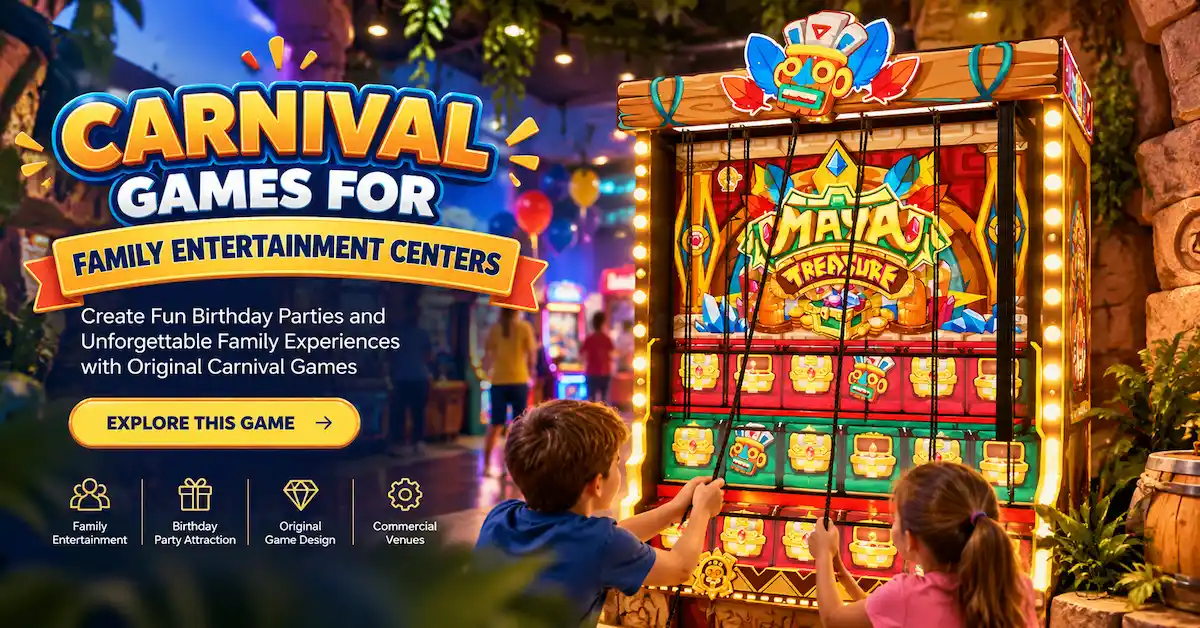
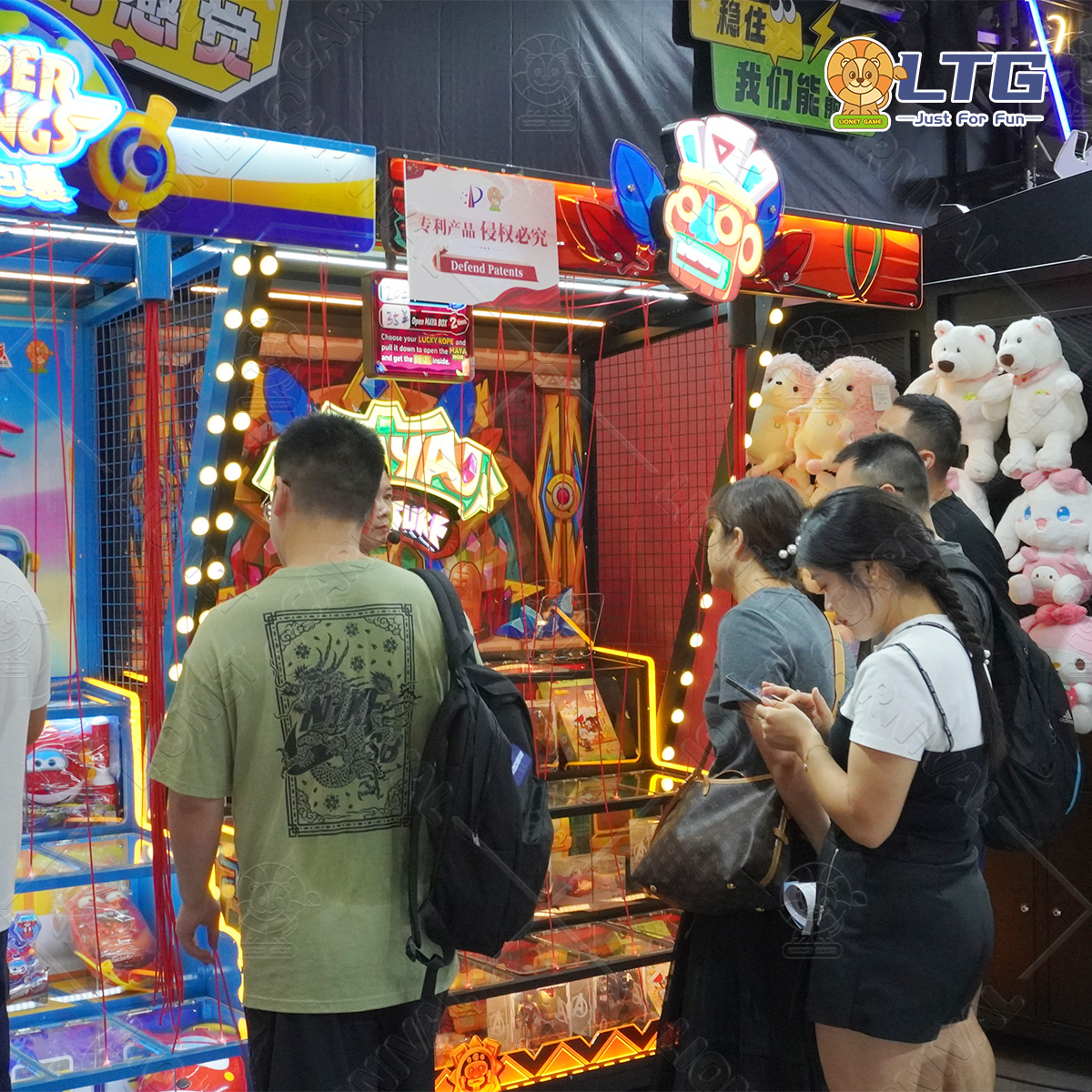
Mayan Treasure uses a rope-pull concept with 18 treasure chests described on its product page. The mechanic gives the host a straightforward way to introduce the first station: show the ropes, explain the choice and demonstrate how a round concludes. The listed configuration accommodates two players. Before marketing it to a particular age group, confirm the actual controls and intended supervision with the manufacturer.
Station B: A skill game spectators can follow
Magic Bar presents a ring-toss challenge with 100 illuminated bottles. Different bottle colors are associated with different prizes in the published description. As a middle station, it creates a different kind of action from rope-pulling: guests can watch where the ring lands, then compare attempts. Confirm prize rules, ring recovery, staff involvement and the final game configuration before creating party instructions.
Station C: A finale that brings friends together
Mega Hoops offers five basketball lanes, continuous ball circulation and live time, score and ranking displays. Its published five-player layout makes it a useful reference when an FEC wants a competitive group ending. The operator should still decide how to handle a party larger than five, how to rotate the next set of players, and whether a spectator group can watch without blocking the main route.
Explore the original game formats
Review the individual products before building a group package. Their listed dimensions and player counts are a starting point—not a finished floor plan.
Browse Indoor Carnival Games → See Multiplayer Games →3. Compare Published Equipment Data Before Sketching the Layout
Original carnival game design provides the playing concept; dimensions and player positions determine whether it can work in a specific location. For the following products, LIONET publishes the dimensions and player capacity shown below. The dimensions follow width × depth × height, and reflect the listed product configurations.
| Game | Published dimensions (mm) | Players | Possible circuit role |
|---|---|---|---|
| Mayan Treasure | 1800 × 1450 × 2500 | 2 | Welcome / discovery station |
| Magic Bar | 3900 × 2800 × 2850 | 2 | Ring-toss skill station |
| Mega Hoops | 5280 × 3500 × 3950 | 5 | Multiplayer basketball finale |
| Double Fun Carnival | 4830 × 3050 × 2680 | 4 | Alternative multi-game stop |
| Dreamy Carnival | 5437 × 5437 × 3268 | 6 | Central multi-directional attraction |
Important planning distinction: These are product dimensions, not the complete operating footprints. A usable layout also needs room for play, waiting guests, adult spectators, staff access, cleaning and movement between stations. Final installation conditions and ordered configurations should be confirmed individually.
Compare equipment by the role it serves, not by size alone. A larger multi-lane game may provide an attractive group finale, yet a smaller station can be more appropriate as an introductory activity. Likewise, listed simultaneous player capacity does not establish guests served per hour: actual throughput depends on the session format, rules, transition time and how groups are managed.
4. Build the Guest Rotation Around the Slowest Station
Suppose an FEC plans a party circuit for twelve guests. One possible organizing method is to divide them into three groups of four and move them among three stations. This is an illustrative host-planning exercise, not a claim that the listed machines can each serve four people simultaneously. Mayan Treasure and Magic Bar list two-player configurations, while Mega Hoops lists five lanes.
Group 3: Finale
Group 3: Discovery
Group 3: Skill
At each two-player station, the four-person group would need at least two turns before everyone had an opportunity to participate. That is why equipment player counts cannot be treated as a group-session capacity. A pilot session should record how long guests actually take to understand, play, reset and change places before the FEC promises a fixed event duration.
If the first station holds the group while the next is empty, change the host instructions or group size before investing in another machine. Other practical adjustments include staggering group starts, using a different activity to occupy waiting guests, or keeping a party in one zone instead of making it cross the entire arcade.
What should the event host record during a trial?
- How long it takes to explain the rule to a new player.
- How many turns the booked group requires at each station.
- Which reset or prize step needs staff attention.
- Where waiting guests naturally stand and whether that obstructs circulation.
- Whether participants can hear instructions and read the result.
- Whether the actual experience fits the party schedule without rushing guests.
5. Choose a Layout That Fits Your Venue, Not an Imaginary Standard Floor Plan
Many FECs place birthday areas next to attractions, but a usable circuit needs more than an attractive row of cabinets. Review your actual entrance, existing arcade machines, party room, paths to restrooms, storage access and power locations. The activity should be easy to find without forcing unrelated visitors to pass through a private group.
Compact arrangement: adjacent stations with a shared host point
Where space is constrained, consider putting complementary games within an easy-to-supervise area. A multi-game attraction can sometimes replace several separate machines, but only after checking the exact footprint and game modules. Double Fun Carnival, for instance, is described as combining two to four carnival games in one attraction, with four listed player positions. Confirm the included modules before assuming it replaces any specific set of stations.
Larger arrangement: a visible center with separate activity edges
Dreamy Carnival uses a circular layout and offers six or more interchangeable game combinations in the product description. Its full-circle access can be visually appealing, but it also makes the surrounding space part of the operating plan. Draw every active player position and where spectators may gather before treating the central floor area as available.
Whichever arrangement you choose, request product drawings and site-specific installation information. Ceiling height, entry openings and routes for bringing equipment indoors may rule out a configuration that otherwise looks attractive in photographs.
6. Prepare a Party Session That Works for Families and Staff
Family groups rarely behave as perfectly timed queues. Some children may want extra explanation; some adults may observe rather than participate; others may want a second attempt. The host should know the intended sequence and what happens when a guest elects to skip a station. Avoid advertising universal suitability for every child without checking the specific equipment and your operating plan.
- Welcome: explain the three-stop route and show where the group begins.
- Instructions: prepare a short demonstration for each different game action.
- Turns: confirm the player positions and how non-playing guests will wait.
- Prizes: establish actual prize rules, inventory control and who hands out rewards.
- Scores: decide whether the party competes individually, as teams or just for fun.
- Finish: set a clear gathering point before the group returns to its party area.
- Daily checks: assign who inspects the equipment, reports faults and manages resets.
This checklist describes an operator-designed event program, not a pre-packaged service or guaranteed function included with a LIONET machine. Put the agreed rules in staff materials and test them before selling the activity as part of a birthday booking.
7. How Original Design and Manufacturing Shape the Experience
A China carnival game supplier has a more useful story to tell when its products demonstrate identifiable playing ideas. LIONET presents itself as a designer and manufacturer of original carnival and midway games for commercial entertainment venues. The published models provide concrete examples of how mechanics, visual feedback and structural arrangement change the experience.
Mayan Treasure centers its action on choosing a rope. Magic Bar turns bottle color and ring placement into visible outcomes. Mega Hoops places five basketball lanes beside one another, with live displays that let players compare results. Double Fun combines different game choices within one structure, while Dreamy Carnival uses an open circular format. These are distinct design approaches—not generic promises that every game is equally suitable for every FEC.
LIONET's company introduction identifies structural fabrication, game assembly, product testing, and packing and delivery as parts of its manufacturing capabilities. Buyers can use that information to frame specific questions: What happens when a play finishes? How is a mechanism reset? Which accessories are supplied? What inspection records can be shared for the ordered configuration? Such questions connect creative design to commercial operation.
For operators seeking carnival games for family entertainment centers, that link between original gameplay and everyday usability is more valuable than choosing a machine only because its cabinet is visually impressive.
8. Compare a Birthday Circuit With Ordinary Walk-Up Play
The same game may be operated differently inside a hosted party and on an ordinary open floor. Your purchasing decision should consider both contexts if the FEC intends to use the equipment outside reserved event times.
| Decision | Hosted birthday circuit | Regular FEC floor use |
|---|---|---|
| Player order | Group rotates on a host's cue | Individual walk-up participation |
| Instructions | Brief group demonstration | Visible rules for new arrivals |
| Scoring | Shared challenge or party format | Individual score or optional group challenge |
| Prizes | Pre-agreed party rules and inventory | Standard operating prize policy |
| Waiting area | One identifiable group at a station | Variable queues from public foot traffic |
| Staffing | Assigned event host as planned | Normal venue operating arrangement |
If a machine requires dedicated staff attention during a private session, include that responsibility in the party program. Do not assume that a listed electronic score display makes an attraction fully self-operating, or that a two-player booth has the same throughput as a multi-lane game.
9. Ask a China Carnival Game Manufacturer the Right Product Questions
When comparing original equipment for an FEC birthday program, ask about the exact machine configuration rather than requesting a general catalog and guessing the operational details. The following checklist can be sent with the venue brief.
- Product scope: Which current model and game version are being quoted?
- Dimensions: Can the supplier provide the approved width, depth, height and positioning drawing?
- Gameplay: Can we view a full round, from player start to reset?
- Participants: How many active positions does the quoted version have?
- Operating role: Which actions require the venue's staff?
- Prizes: Which prize-related functions are part of the equipment and which are venue-managed?
- Site: What power, entry route, assembly and maintenance access information is needed?
- Documentation: Which packing, setup, operation and replacement-part information can be provided?
- Commercial details: What quantities, configuration options and delivery terms will the quotation cover?
These questions also help importers and distributors understand how a game may be positioned for commercial FEC customers in their markets. A buyer with a clear intended program can evaluate whether the selected product helps achieve that purpose.
Turn a party concept into a product shortlist
Share your FEC floor plan, location, party group size, preferred games and intended opening schedule with the LIONET team for a project-specific discussion.
Discuss Your FEC Project → View Venue Solutions →10. What Should Go in the First FEC Equipment Inquiry?
A focused inquiry is more productive than asking which machine is 'best' for an unspecified family audience. Describe the project in terms that allow the manufacturer to consider your particular venue and the guests it serves.
- Venue location and whether the installation is inside an existing FEC or part of a new site.
- Floor plan, available equipment area, ceiling height and access route.
- Expected party format, approximate group size and intended participant profile.
- Preferred experience: welcoming choice, ring-toss skill, basketball competition or combined modules.
- Available staff, preferred prize policy and whether machines also serve regular walk-up guests.
- Models being considered, quantities and known power or delivery constraints.
- Open questions that must be resolved before approving the design or ordering.
Relevant source material is available in the LIONET product catalog and venue solutions. Ask for the current specification for any shortlisted product; commercial terms and final configurations should be confirmed for the actual order.
Frequently Asked Questions
Which carnival games work for family entertainment center birthday parties?
Choose games that perform different jobs in the session: a clear introductory activity, a skill challenge and a group finale. Mayan Treasure, Magic Bar and Mega Hoops illustrate these different formats in LIONET's published product range. Suitability depends on the intended participants, supervision and final game setup.
Can one multi-game attraction replace three individual stations?
It may replace some separate game activities. Double Fun Carnival and Dreamy Carnival show how multiple games can be presented within a combined attraction. However, the actual modules, participant positions and venue footprint must be checked before treating them as equivalent to a three-stop route.
How many people can play Mega Hoops at once?
The published Mega Hoops configuration lists five player lanes. This does not define a complete party-group capacity or a guaranteed number of guests served within a fixed time period.
What is the biggest layout mistake when buying FEC carnival games?
Planning from cabinet dimensions alone. The actual zone also needs usable space for people playing, waiting, watching, moving and maintaining equipment. Start with the floor plan and verify equipment positioning before ordering.
What should buyers send to a China carnival game supplier?
Send a floor plan, intended audience, preferred gameplay, likely group size, product shortlist, quantities, available staffing and destination. This helps turn a broad product inquiry into a specific discussion about a suitable game combination.
Conclusion
The best carnival games for family entertainment centers are the ones that make sense together for the venue's real guests and operations. For a birthday-party challenge circuit, begin with distinct play experiences, verify actual LIONET product features, and test the group rotation before finalizing your equipment shortlist.
LIONET's original carnival game designs provide several directions to explore, from rope-pull and ring-toss stations to five-lane basketball competition. Compare the equipment and contact LIONET with your venue brief to discuss a practical starting combination.