Quick answer: Choose a midway game manufacturer by checking five things: whether its games fit your venue and audience, whether it can document the proposed build, how the games will operate during busy periods, what the complete installed project will cost, and who will support maintenance after delivery. Compare the same configuration across suppliers. Approve a layout, an acceptance checklist and a written commercial scope before committing to production.
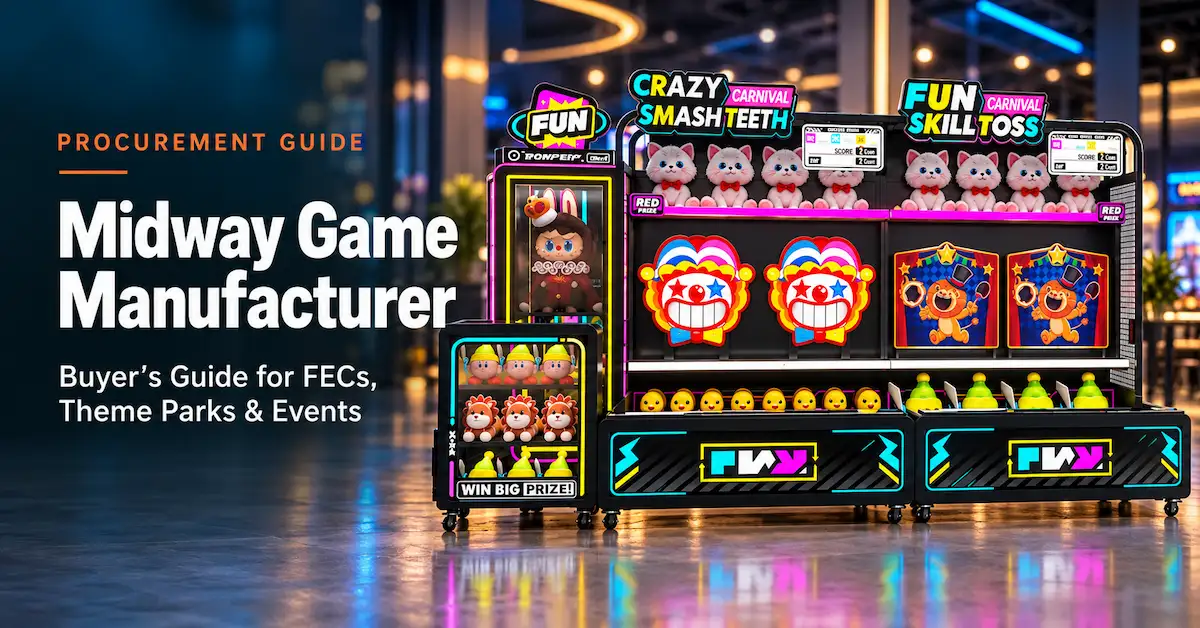
A convincing product image cannot show queue congestion, reset time or how easily an operator replaces a worn component. These details become expensive after installation, especially when your opening date, staffing budget and available floor area are already fixed.
This guide explains how to turn supplier selection into a practical procurement process. It combines published Lionet product examples with buyer checklists and clearly labeled calculations, helping you prepare a brief that produces useful proposals rather than a collection of unrelated prices.
What should a midway game manufacturer actually deliver?
A midway game manufacturer designs or builds commercial carnival attractions such as throwing games, target challenges, prize games and interactive game booths. The useful deliverable is a documented system: the structure, gameplay, operating requirements, service access and supply scope all need to match the buyer's project. A carnival game equipment supplier should make that scope clear before quoting.
For a venue operator, the purchase is also an operating decision. A game must attract the intended players, explain its rules clearly, reset predictably and fit the surrounding circulation. For a distributor, consistent configurations, spare parts and understandable documentation can matter as much as the appearance of the first shipment.
Manufacturer, distributor or trading supplier: compare responsibility
Buying directly can simplify technical changes when the factory controls engineering and production. A regional distributor may offer useful installation or local service. Either route can work; establish who owns the drawings, approves substitutions, handles defects and supplies replacement parts.
Ask your midway game manufacturer to identify which operations it performs internally and which it sources. Request evidence for the specific product you intend to buy. A factory tour becomes more useful when it follows the actual fabrication, assembly, testing and packing route of your proposed equipment.
Lionet's manufacturing overview describes structural fabrication, game assembly, product testing and packing, alongside original carnival game development. Use those capabilities as the starting point for a discussion about your model, quantity and acceptance requirements.
Choose midway games for FECs, theme parks and events
The right supplier proposal begins with the intended use. A permanently installed indoor attraction, a touring festival booth and a distributor's standard product line face different constraints. Define the environment, audience, staffing model and commercial objective before shortlisting equipment.
| Buyer or venue | Primary decision | Evidence to request |
|---|---|---|
| FEC or indoor play venue | Balance family participation, floor area and repeat play. | Operating layout, game cycle demonstration, service clearances and staffing assumptions. |
| Theme park | Fit the midway theme and expected peak demand. | Queue plan, reset procedure, environment specification and maintenance access. |
| Event or festival organizer | Open on schedule and manage repeated transport. | Packing dimensions, assembly sequence, crew requirements and site suitability. |
| Distributor or importer | Build a repeatable, supportable product range. | Configuration control, parts identification, documentation and regional adaptation scope. |
A family-focused FEC may prioritize easy participation and manageable prize costs. A social entertainment venue may prioritize visible competition and group interaction. An event team may accept a simpler visual treatment if it substantially reduces transport and setup effort.
Lionet organizes its carnival and midway solutions around FEC and indoor play, events and festivals, theme parks, and distributors. Identify the closest application, then explain the conditions that make your project different.
Define the fit boundary: These attractions suit buyers planning carnival-style participation and commercial venue operation. A project needing a mechanical ride, a home-use toy or a validated fully unattended installation requires a different specification and supplier review.
Compare commercial midway game formats before comparing prices
Product names alone do not define the operating model. Two booths can look similar while using different prize policies, player positions and reset procedures. Ask for a demonstration of the exact game configuration, including payment, instructions, play, result handling and preparation for the next customer.
| Format | Potential venue value | Operating question |
|---|---|---|
| Midway booth | A recognizable carnival attraction with visible play and prize presentation. | How much space do the player position, throw area and reset procedure require? |
| Prize-every-time game | A clearly communicated reward proposition for the selected audience. | What is the landed prize cost per paid play, including replenishment? |
| Skill carnival game | A repeatable challenge that players can understand and improve at. | How are rules, equipment condition and difficulty kept consistent? |
| Social carnival station | Shared competition and spectator interest. | How many positions can operate together, and who manages group turnover? |
These formats can overlap. A social station may contain skill challenges; a modular attraction may accommodate several game choices. Confirm the actual combination instead of assuming that every product in a category has identical staffing, payment or reward behavior.
Build a complementary game mix
A useful mix offers different participation patterns: an approachable game for first-time players, a challenge with replay appeal and a format that supports group interaction. Adding several nearly identical challenges can increase equipment spend without giving visitors a meaningful reason to try another station.
Review the current Lionet game range with an operating brief beside it. Ask the supplier to explain what each proposed attraction adds to the zone and how it affects staffing, circulation and prize inventory.
Compare game formats for your venueRead the specifications as installation requirements
A specification table should help your project team make decisions. Dimensions determine access and placement. Listed power informs electrical planning. Weight affects handling and floor review. Player capacity describes a configuration; it does not establish how many paid plays the attraction will achieve.
| Specification | X-Carnival | Dreamy Carnival |
|---|---|---|
| Dimensions W × D × H | 1,100 × 900 × 1,950 mm | 5,437 × 5,437 × 3,268 mm |
| Listed player capacity | 1; customization stated | 6; customization stated |
| Listed power | 330 W | 3,300 W |
| Listed weight | 180 kg | 1,200 kg |
| Listed use type | Indoor | Indoor |
| Game configuration described | 11 games | 6+ interchangeable combinations; 360° access |
| Calculated W × D bounding footprint | 0.99 m² | 29.56 m² |
Sources: X-Carnival product specifications and Dreamy Carnival product specifications. Footprints are calculated from published width and depth, rounded to two decimals; they exclude operating clearances. Confirm the ordered configuration in the quotation.
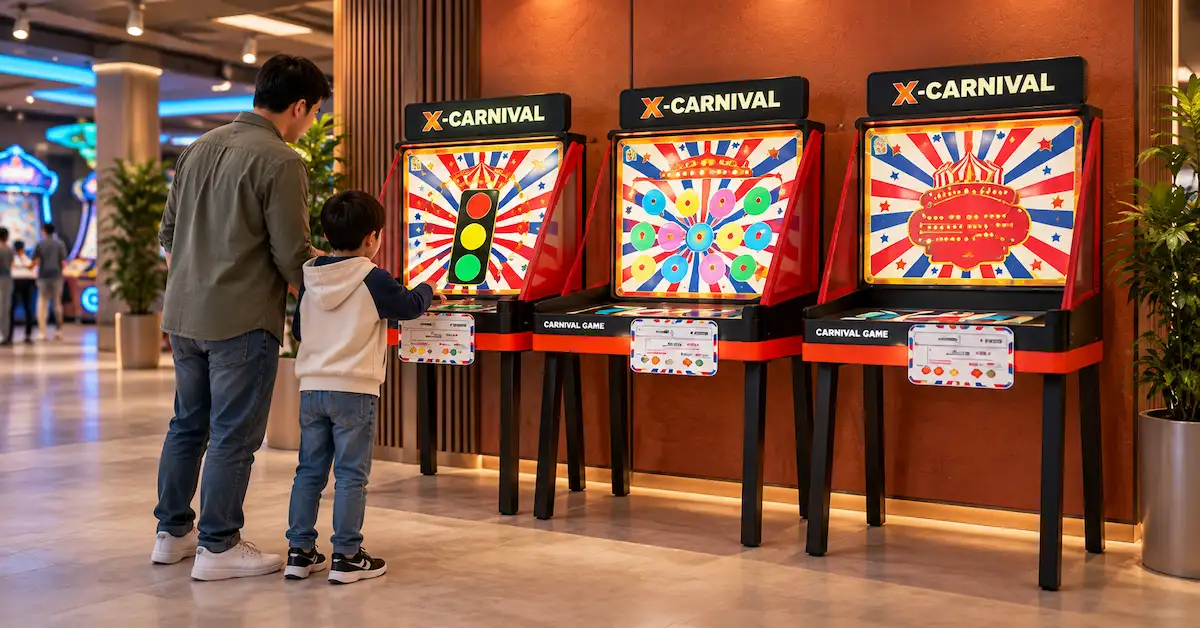
X-Carnival illustrates a compact cabinet option. Its selectable game count and listed single-player configuration answer different questions. Ask how the proposed arrangement handles players, game selection and resetting before using it in a capacity calculation.
Dreamy Carnival illustrates a larger attraction with access around the structure. That arrangement creates a different layout problem: circulation, spectators and service access need consideration on every active side. Evaluate the complete operating zone rather than comparing cabinet area alone.
Footprint is not operating area. X-Carnival's published width and depth calculate to 0.99 m². This is the rectangular cabinet envelope, not a complete space allowance for a player, queue, access route or technician.
Plan the usable floor area and player flow
When planning theme park midway equipment or a new FEC zone, give your midway game manufacturer a measured plan showing entrances, columns, ceiling height, power locations and nearby attractions. Include the route from the unloading point to the final position. A game can fit its intended location yet fail to pass through a doorway or service lift.
Separate five areas during planning: the equipment envelope, player movement, waiting space, circulation and maintenance access. Some areas may overlap during quiet periods, but the peak-period plan must show how customers and staff move without depending on an empty neighboring zone.
Keep circulation independent of game participation
Place prize collection and payment activity where they do not block the next player or the main aisle. Review where spectators stand and where staff retrieve game pieces. A visually prominent attraction can create a bottleneck if all these tasks happen at the same narrow frontage.
For U.S. projects, the U.S. Access Board's Guide to the ADA Accessibility Standards, Chapter 4: Accessible Routes describes route continuity and walking-surface requirements. Treat accessibility as a separate layout review by the project team; equipment dimensions alone do not establish venue compliance.
Approve utilities and installation access
Have the responsible electrical professional review the configured load, local supply and connection arrangements. Confirm service-panel access, cable routing and any network or payment-system requirements. These details belong in the approved installation package, alongside assembly drawings and the handling plan.
If the venue layout is still developing, ask Lionet to review the space-planning requirements before finalizing your equipment mix. Moving a proposed attraction on a drawing is usually easier than redesigning the zone after delivery.
Evaluate throughput, staffing and prize handling together
Throughput means completed player plays over a defined period. It depends on the entire cycle: explaining rules, taking payment, playing, checking results, issuing prizes and resetting. Player positions indicate simultaneous capacity; they are only one input to the hourly result.
Theoretical player plays per hour = simultaneous player positions × 3,600 ÷ complete cycle time in seconds
Illustrative calculation: A hypothetical four-position game with a 90-second play period and 30 seconds for turnover has a 120-second complete cycle. Its theoretical capacity is 120 player plays per hour. At an assumed 60% combined utilization, the planning estimate becomes 72 player plays.
This example is a calculation method, not a measured Lionet result. Actual utilization reflects demand, unfilled positions, staffing and interruptions. Request a timed demonstration and record both a smooth cycle and a cycle that includes normal customer questions or prize handling.
Identify the task that limits the next round
A game may reset quickly while prize selection takes much longer. Several booths may share payment staff and create a common queue. Watch each handoff. Buying more player positions will not solve a bottleneck caused by one payment point or a slow replenishment procedure.
Ask whether the proposal requires a dedicated attendant, shared supervision or another verified operating model. Distinguish automatic scoring from unattended operation. Confirm who handles exceptions, disputed results, missing pieces, cleaning and customers who need help.
Keep a written prize policy covering reward eligibility, inventory levels, replenishment and daily reconciliation. A clear policy supports predictable cost and consistent customer communication. It also allows finance and operations teams to assess the same commercial model.
Compare installed cost and ownership economics
A low equipment price can still produce a costly project. Ask each midway game manufacturer for an itemized scope using the same game configuration, destination and delivery assumptions. Separate the purchase price from installation costs and recurring operating expenses.
| Cost group | Items to clarify | Decision value |
|---|---|---|
| Equipment and development | Game modules, controls, artwork, customization, prototype work and included accessories. | Ensures quotations describe equivalent systems. |
| Delivery and import | Export packing, freight, insurance, local handling, duties and applicable taxes. | Identifies the complete landed cost and responsible parties. |
| Site preparation and opening | Electrical work, handling equipment, assembly, commissioning and staff training. | Reveals costs between arrival and commercial operation. |
| Recurring operation | Staff, prizes, payment charges, cleaning, utilities, rent allocation and maintenance. | Supports an operating cash model rather than revenue-only projections. |
| Service and renewal | Wear parts, spare stock, repairs, artwork renewal and downtime. | Tests whether the attraction remains supportable over its intended life. |
Use a sensitivity calculation before approving investment
Hypothetical example: Assume an installed investment of $18,000 and 120 paid plays per day at $3 each. Daily revenue is $360. At $0.60 average prize cost and $0.10 transaction cost per play, those variable costs total $84.
Assume daily staffing of $90, allocated space cost of $80, and combined maintenance and utilities of $20. Daily operating cash contribution is $86. Simple payback is approximately 209 operating days, before financing, income taxes, depreciation and any costs omitted from this example.
If demand falls to 90 paid plays while fixed costs remain unchanged, revenue becomes $270, variable costs become $63 and daily contribution falls to $17. Simple payback increases to approximately 1,059 operating days. Small changes in demand can therefore change the investment case substantially.
Use your own numbers: These inputs are illustrative assumptions, not Lionet prices, revenue forecasts or payback promises. Test quieter periods, prize-cost increases, staffing changes and downtime. If operating contribution is zero or negative, simple payback is not achievable under that scenario.
For space comparison, divide expected contribution by the full allocated operating area. Use the same time period and cost definitions for every option. Revenue per cabinet square meter can exaggerate performance when queues and circulation occupy additional space.
Verify materials, workmanship and quality-control evidence
The useful question is not whether a supplier says its products are durable. Ask what the selected build uses, how it is assembled and what evidence confirms acceptable performance. Your midway game manufacturer should connect its quality claims to identifiable materials, components and tests.
Inspect the parts exposed to everyday use
Review the frame, joints, fasteners, panel edges, graphics, game pieces and service doors. For metal components, clarify the material and finish. For acrylic or board panels, inspect edge treatment, fastening and replacement access. A material name alone does not establish resistance to impact, moisture or repeated handling.
Request a parts list for controls and other critical components. Confirm availability, identification and substitution rules. If a replacement requires removing major decorative panels, evaluate the service time before approving the design.
Agree the acceptance checklist before production
- Configuration: Match dimensions, player positions, game modules and approved artwork to the order.
- Function: Demonstrate the full game cycle and any included scoring, lighting or payment functions.
- Repeatability: Agree the repeated-operation test method and record exceptions or resets.
- Workmanship: Check finishes, assembly, accessible edges and component mounting against approved criteria.
- Service: Demonstrate access to specified wear parts and routine maintenance points.
- Shipment: Match packing, labels, accessories and documentation to the shipment list.
Request model-specific compliance evidence where your destination requires it. Confirm the report scope, tested configuration, issuing organization and applicable edition. A certificate for a component or another model does not automatically establish compliance of the complete attraction you are ordering.
ASTM International's F3559-25, Standard Guide for ASTM F24 Standards Governing Lifecycle Management of Amusement Rides and Devices is a reference for understanding the F24 standards framework. Applicability still requires review of the particular equipment and jurisdiction; this guide is not a claim that every midway booth falls under every F24 standard.
Discuss the evidence package with Lionet through its project inquiry page. Identify your destination and required documents early so testing, documentation and approval responsibilities can be included in the proposed scope.
Define OEM and ODM customization before approving a concept
Customization can range from new artwork on an existing attraction to changes in dimensions, gameplay or controls. Those changes involve different engineering, validation and production effort. Define what must change and what can remain standard before asking for a custom carnival game booth quotation.
For this buying process, OEM means manufacturing to an agreed buyer specification; ODM means the supplier participates in development or adaptation. Suppliers sometimes use these terms differently. Write the actual responsibilities into the project scope rather than relying on the label.
Use staged approvals for carnival game ODM
- Brief: Agree audience, venue constraints, theme, budget range and required game behavior.
- Concept: Review the proposed layout, appearance, participation model and access requirements.
- Prototype or sample: Confirm the validation method for the changes being introduced.
- Design freeze: Approve drawings, artwork, component choices and remaining technical details.
- Production and acceptance: Build against the approved revision and complete the agreed checks.
Lionet's ODM development overview describes concept, gameplay, prototyping, testing and production support. Ask which stages your project needs, what each stage delivers and which decisions must be completed before a production schedule can be confirmed.
Clarify ownership and permitted use of artwork, drawings, software and tooling where relevant. Identify approval authority and the treatment of later revisions. For distributors, discuss regional adaptation and any exclusivity request explicitly; it should not be assumed from a customized color scheme.
Discuss your custom midway game briefConfirm capacity, lead time and delivery milestones
A production estimate is useful only when its starting conditions are clear. Ask your midway game manufacturer when the quoted lead time begins: order acceptance, payment receipt, design approval or another agreed milestone. Confirm whether prototype work and destination documentation are included.
For a fixed opening date, work backward from site commissioning. Separate factory readiness, transport, import clearance, local delivery, installation and staff preparation. A shipment leaving on time does not mean the attraction will be ready for customers on the same date.
Check the schedule against the actual order
Ask how your quantity and customization affect available production slots. Request milestone dates and the approval deadlines that support them. Capacity figures become more meaningful when connected to your build, current commitments and the testing required before packing.
Confirm packed dimensions, gross weights, package count and whether assembly is required. Plan unloading and storage around the actual shipment. For temporary events, include dismantling, repacking and the expected number of transport cycles in the brief.
State the agreed shipping responsibilities and destination clearly. Identify who handles freight booking, insurance, import procedures, unloading and damage inspection. Keep these responsibilities visible in the commercial comparison so a partially included delivery service does not look like a lower complete project cost.
Environment must be explicit: The two reference models above are listed as indoor products. An outdoor event brief needs a separately confirmed configuration covering weather exposure, installation and operating limitations. A project application label does not establish an outdoor equipment rating.
Build maintenance and after-sales support into the purchase
Serviceability affects commercial availability. Ask how staff inspect, clean and reset the attraction, which parts wear most frequently and how replacements are ordered. Request manuals and parts identification that match the delivered revision, especially when several locations will operate similar equipment.
Agree the initial spare-parts package by considering failure impact and replacement lead time. A low-cost part can still cause an expensive interruption if it stops the game and cannot be identified or shipped quickly.
Clarify the support route
Establish the contact channel, information required for fault diagnosis and escalation process. Useful details include the serial number, game configuration, error description and photographs or video. Discuss who performs repairs locally and whether replacement work requires trained technicians.
Request written warranty terms describing coverage, exclusions, consumables, labor responsibilities and freight treatment. Compare the remedy and practical service arrangements. A warranty period on its own says little about how an operator restores service during a busy week.
Before opening, train staff on rules, prize handling, normal inspections and the response to an abnormal condition. Keep a simple maintenance log and track interruptions by cause. These records support troubleshooting and help you judge whether the game mix or operating procedure needs adjustment.
Use real project evidence to assess delivery capability
A case study becomes useful when it shows work comparable to your project. Look for the application, equipment role, site constraints and support delivered. Photographs demonstrate an installation context; commercial results require their own documented evidence.
Lionet's published project portfolio includes WOG in Dubai, TIMEZONE family entertainment locations, JOYPARK indoor entertainment and MGM HAIXIN SAND, described as a 3,500 m² outdoor entertainment project. These examples offer different contexts for a supplier discussion.
The Haixinsha carnival project account describes delivery, on-site installation and debugging, alongside equipment monitoring and operating support. Ask how the comparable services would be scoped for your location, timeline and local crew.
Turn project examples into verification questions
- Which parts of the referenced delivery and installation work are relevant to our project?
- What responsibilities stayed with the operator or local contractor?
- What assembly documents and support arrangements will our order receive?
- Can the proposed configuration be demonstrated under comparable operating conditions?
Published projects should strengthen your understanding of delivery capability without replacing checks on your own equipment. Venue scale, demand and commercial terms differ. Assess the proposed build and service scope directly rather than transferring another installation's presumed economics to your investment model.
How to compare midway game manufacturer proposals
A scorecard keeps procurement, operations and finance focused on the same evidence. The example below is a buyer worksheet, not a supplier certification. Adjust the weights to your project, then score every shortlisted midway game manufacturer against equivalent information.
| Criterion | Weight | Evidence basis |
|---|---|---|
| Venue and audience fit | 25% | Approved layout, environment and game participation model. |
| Operating performance evidence | 20% | Timed game cycle, staffing tasks and prize handling. |
| Build and quality evidence | 20% | Specifications, component identification and agreed acceptance checks. |
| Ownership economics | 15% | Comparable installed scope and operating cost assumptions. |
| Delivery plan | 10% | Milestones, packing, site responsibilities and commissioning scope. |
| Service and spare parts | 10% | Support route, parts availability and written warranty terms. |
Use a consistent one-to-five scale, from limited evidence to fully documented project fit. Multiply each rating divided by five by its weight, then add the results. Record the evidence beside the score so a polished presentation does not receive the same credit as a verified demonstration.
Keep mandatory requirements outside the weighted total. Physical access, applicable compliance requirements and essential opening-date conditions need their own pass-or-fail review. Strong appearance or favorable pricing cannot compensate for an unresolved requirement that prevents installation or operation.
Prepare a brief that produces a useful quotation
A detailed brief gives a midway game manufacturer the information needed to recommend a configuration and expose trade-offs. You do not need every decision finalized, but separate confirmed requirements from areas where you want supplier advice.
- Destination: Country, city and delivery location.
- Venue: FEC, mall, theme park, resort, temporary event or distributor project.
- Space: Measured plan, ceiling height, access route and usable game-zone area.
- Environment: Indoor conditions or the specific outdoor exposure requiring review.
- Audience: Families, teenagers, adults, groups or a defined combination.
- Operation: Staffing plan, payment approach, prize policy and expected busy periods.
- Game mix: Preferred challenges, quantities and any reference models.
- Customization: Theme, artwork, dimensions or gameplay changes.
- Commercial scope: Budget range, delivery responsibilities and required documentation.
- Timing: Opening date, approval process and installation constraints.
Ask for a recommendation that explains why the proposed games fit your brief, alongside an itemized quotation and outstanding questions. That response shows how the midway game manufacturer translates your brief into a practical proposal. It supports internal approval by making layout, operating and delivery assumptions visible.
Frequently asked questions
What should I check first when choosing a midway game manufacturer?
Start with venue fit: audience, environment, operating area and staffing. Then request evidence for the proposed configuration, including specifications, a full-cycle demonstration, acceptance checks and service arrangements. Compare equivalent scopes before using price as the deciding factor.
How much do commercial midway games cost?
Cost depends on the configuration, quantity, customization and delivery scope. Compare equipment, development, freight, import, site preparation and commissioning separately. A project quotation is more reliable than an unsourced generic price range because it identifies what is included and what remains the buyer's responsibility.
How much space should I allocate to a game?
Allocate the equipment envelope plus player movement, waiting, circulation and maintenance access. Use an approved layout rather than cabinet dimensions alone. X-Carnival's published width and depth calculate to a 0.99 m² cabinet envelope; that does not define its complete operating zone.
Can indoor midway games be used at an outdoor festival?
Indoor classification does not establish outdoor suitability. Give the supplier the expected exposure, site conditions and installation plan, then obtain written confirmation for the selected build. Review weather protection, utilities and operating limitations as part of the project specification.
Can Lionet customize themes, dimensions or gameplay?
Lionet describes ODM support from concept and gameplay through prototyping, testing and production. Confirm the feasibility and scope of each requested change. Artwork adaptation and changes to structure or controls require different approval and validation work, so they should be quoted explicitly.
What MOQ and lead time should I expect?
Request MOQ and lead time for the exact model, quantity and customization. Define the schedule's starting milestone and separate development, production, shipping and installation. Treat the supplier's written project proposal as the basis for planning rather than assuming a universal quantity or delivery period.
How many players can a midway game serve per hour?
Use simultaneous player positions and the complete cycle time to calculate theoretical capacity, then adjust for real demand and operating interruptions. A player count is not a throughput measurement. Request a timed demonstration including payment, instructions, prize handling and reset.
Do all midway games require a dedicated attendant?
Staffing depends on the actual game and operating model. Confirm payment, supervision, reset, replenishment and exception-handling tasks. Automatic scoring does not by itself prove unattended operation. Use a demonstration and a written staffing plan to determine whether supervision can be shared.
Which certificates and inspection records should I request?
Request documents relevant to the selected configuration and destination. Check the model identity, report scope, issuing organization and applicable edition. Separately agree factory acceptance records for functionality, workmanship, service access and shipment completeness. General supplier credentials do not replace product-specific evidence.
What information should I send to request a Lionet quotation?
Send your destination, venue type, measured floor plan, audience, preferred game formats, quantity, budget range and opening date. Include customization, operating and documentation requirements. This gives Lionet a practical basis for discussing the equipment mix, delivery route and outstanding technical questions.
Conclusion
Choose a midway game manufacturer whose proposal connects venue fit, documented equipment, practical operation and complete project costs. Approve the operating layout, acceptance criteria, delivery responsibilities and support terms before production. Use realistic demand assumptions when assessing the investment.
To move from supplier research to a project proposal, share your floor plan and procurement brief with Lionet. A clear description of your space, audience and schedule helps the team discuss a suitable game mix and quotation scope.