What Should a Carnival Game Manufacturer Deliver?
A carnival game manufacturer should help you establish four things before you place an order: whether the game suits your audience, whether it fits the venue’s operating space, whether the approved configuration can be reproduced, and how the equipment will be supported after delivery. A photograph and a unit price cannot answer those questions. Start with an operating brief, compare documented models, and agree how the finished equipment will be accepted. Lionet describes its business around original carnival game design, manufacturing, and ODM development, including gameplay concepts, prototyping, testing, and production. Its company and manufacturing overview provides that starting context. For procurement, the next step is to connect those capabilities to your particular model, installation conditions, and order—not simply to the supplier’s general presentation.
Start With the Venue, Audience, and Staffing Plan
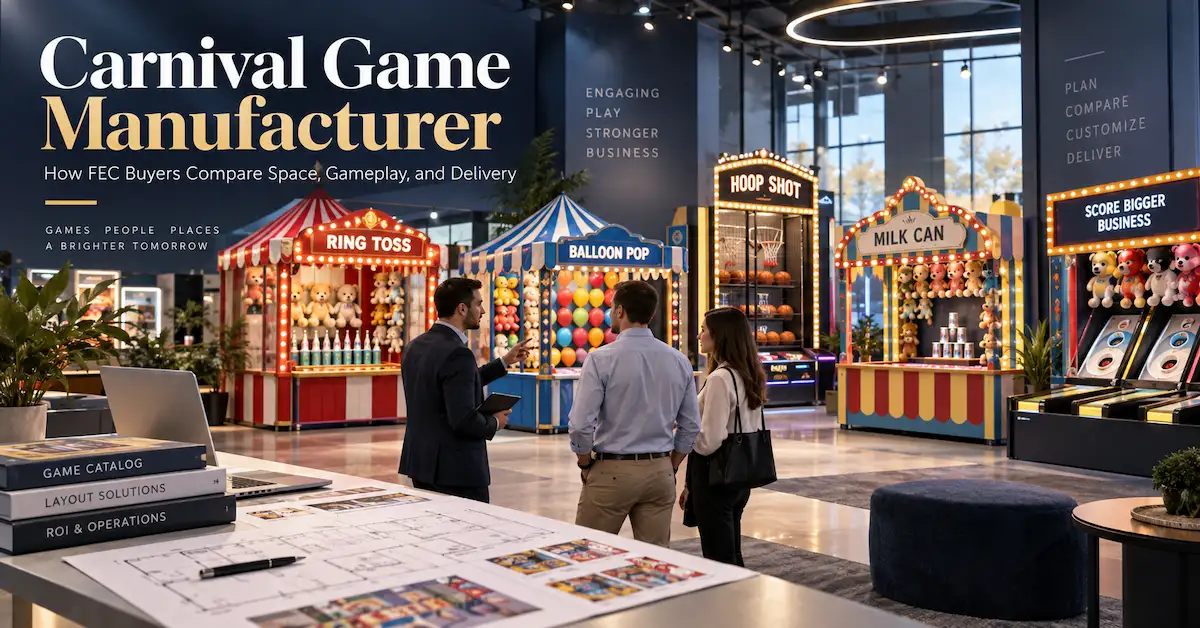
Lionet’s carnival and midway solutions cover family entertainment centers, events and festivals, theme parks, and distributors. Treat these as different purchasing briefs. An FEC buyer should define the intended age mix, available indoor space, and staff involvement; a theme park buyer should specify the installation environment and queue arrangement; an event company should clarify assembly, transport, storage, and operating dates; a distributor should prioritize repeatable configurations and replacement-part identification. When selecting carnival games for family entertainment centers, describe how the game will sit alongside existing attractions rather than ordering from appearance alone. This guide concerns equipment for commercial venues, not home-party supplies. Likewise, do not commission a new custom design when an existing model already meets the project brief, or approve a product for an environment that has not been confirmed.
Compare Actual Game Formats Before Comparing Prices
A useful carnival game manufacturer comparison begins with specific products, not interchangeable descriptions such as “interactive” or “high engagement.” The examples below separate published product features from the questions a buyer should investigate. Player counts refer to the configurations shown on the product pages; confirm the count and participation method for the version being quoted. The final column is a purchasing checklist, not a claim that one format produces better commercial results.
| Lionet Model | Published Game Format | Listed Players | What Buyers Should Examine |
|---|---|---|---|
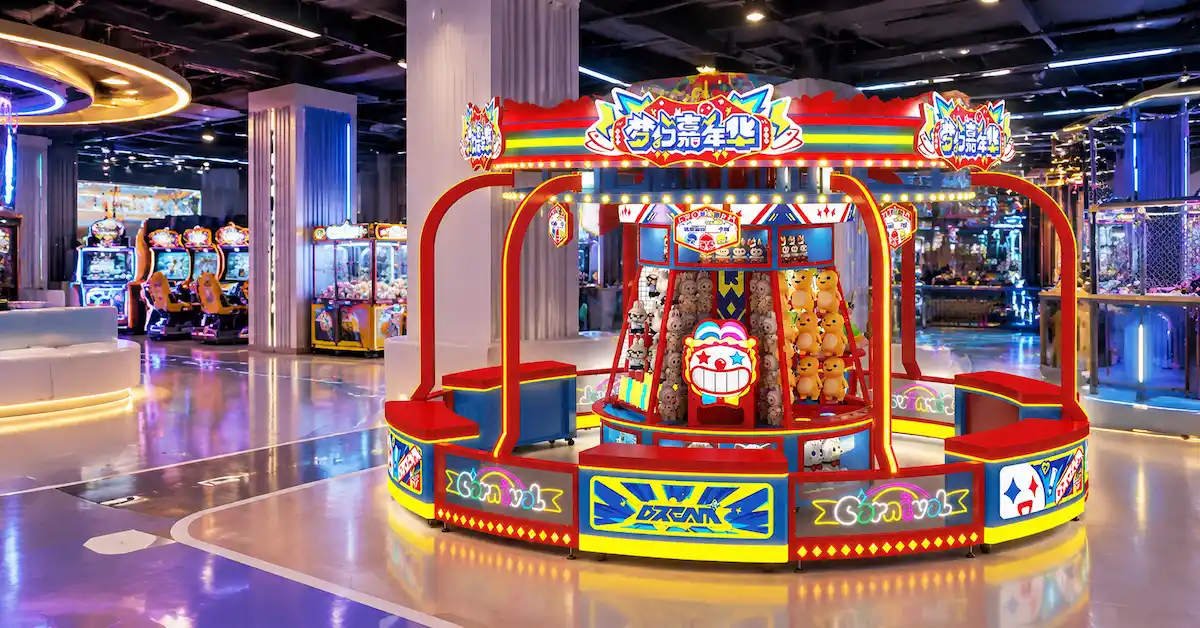
| Dreamy Carnival | Circular attraction with 360-degree access and 6+ interchangeable game combinations. | 6 | Space around all player positions, visibility, game-module selection, and staff access |
| Double Fun Carnival | Combination attraction offering 2–4 carnival games, with Smash Cans and Bottle Club among the described options. | 4 | Which modules are included, how each is reset, and whether the combination suits the intended audience |
| Magic Bar | Ring-toss format featuring 100 illuminated bottles and color-linked prizes. | 2 | Throwing area, ring collection, prize rules, and access for replenishment |
| Mayan Treasure | Rope-pull prize booth described with 18 treasure chests. | 2 | Rope operation, prize replenishment, customer instructions, and reset procedure |
Build a Specification Sheet for the Exact Configuration
Use the following published specifications as an example of how to compare equipment consistently. Dreamy Carnival and Double Fun Carnival have different dimensions, player counts, power listings, and weights; both are listed as indoor products. These are product-page values, not a substitute for the approved order specification. Ask the carnival game manufacturer to confirm the configuration revision, delivery dimensions, packing weight, electrical requirements, and operating clearances before you finalize the layout. In particular, distinguish the equipment’s dimensions from the total space needed for players, queues, attendants, and maintenance.
| Specification | Dreamy Carnival | Double Fun Carnival |
|---|---|---|
| Published dimensions, W × D × H | 5,437 × 5,437 × 3,268 mm | 4,830 × 3,050 × 2,680 mm |
| Listed player capacity | 6 players | 4 players |
| Listed power | 3,300 W | 1,400 W |
| Listed equipment weight | 1,200 kg | 760 kg |
| Listed materials | “Fireproof board,” acrylic, metal | “Fireproof board,” acrylic, metal |
| Listed use type | Indoor | Indoor |
| Order-specific confirmation | Selected games, final layout, utilities, access, packaging, and support scope | Selected modules, final layout, utilities, access, packaging, and support scope |
Test the Complete Game Cycle, Not Just the Winning Moment
Ask each shortlisted carnival game manufacturer for a continuous demonstration of the proposed configuration. Observe the sequence from explaining the rules to starting play, determining the result, handling any prize, resetting the game, and admitting the next participant. Record those stages separately instead of using only the active play time to assess capacity. For competition-focused equipment, verify whether players compete simultaneously, take turns, or compare results after separate rounds; do not assume that “multiplayer” means head-to-head competition. For social formats, examine whether each participant has an understandable role and enough space to join comfortably. Include unsuccessful attempts and ordinary staff intervention in the demonstration. A practical acceptance record should identify the model, configuration, test conditions, observations, unresolved issues, and approval status. That gives purchasing and operations the same reference when the delivered equipment is checked.
Examine Materials, Workmanship, and Service Access
Lionet identifies structural fabrication, game assembly, product testing, and packing and delivery among its manufacturing activities. During supplier evaluation, ask to see how those activities apply to the selected product. Inspect accessible edges, panel alignment, fasteners, moving interfaces, prize compartments, and service access on a representative sample. Where lighting or electrical components are fitted, request the relevant documentation and have qualified personnel review installation requirements. The material descriptions in the specification table also need context: the product pages use the term “fireproof board,” but the description alone does not establish a particular tested fire classification. Request the grade and applicable supporting report when that characteristic matters to your venue. For service planning, have the supplier demonstrate access to routine replacement items and identify them clearly in the parts documentation rather than relying on photographs alone.
Request Quality Evidence That Matches the Equipment
When evaluating a carnival game manufacturer, convert “quality checked” into an agreed inspection scope. Ask which dimensions, assembly details, game functions, finishes, accessories, and packaging items will be checked, how acceptance is recorded, and how unresolved issues are handled. For a multi-game attraction, include every supplied game module rather than approving one demonstration as evidence for all configurations. Request applicable model-specific test reports and compliance documents, identifying the model, configuration, issuing organization, and scope of each document. Do not treat a general company certificate or a logo in a brochure as confirmation of the particular equipment being purchased. Keep the approved specification, artwork, inspection record, and packing list linked to the same order. These are recommended procurement checks; agree the actual tests, documents, and responsibilities with the supplier before production release.
Define Customization and ODM Responsibilities Before Development
Lionet’s published ODM offering covers concepts, gameplay, prototyping, testing, and production. For buyers considering custom carnival games, divide the request into appearance changes, configuration changes, and new development. Ask separately about branding, graphics, game-module selection, structural modifications, player capacity, and any requested changes to the operating sequence. This distinction is more useful than labeling every project “OEM” or “ODM” without explaining the work involved. A request to a custom carnival game manufacturer should identify the baseline model, requested changes, prototype deliverables, approval stages, and acceptance criteria. Record design ownership, permitted use, exclusivity expectations, and change-approval responsibilities in the project agreement. Before approving bulk production, confirm which sample and drawing revision define the finished product; later changes should be reviewed against that reference rather than introduced informally.
Separate Production Lead Time From Opening-Day Readiness
Ask the carnival game manufacturer for an order-specific schedule that distinguishes specification approval, prototype work where required, production, inspection, packing, transport, site setup, and commissioning. Establish what starts the quoted production period and which approvals remain the buyer’s responsibility. For an event or venue opening, work backward from the date the equipment must be installed and checked—not merely the date it leaves the factory. Request confirmation of available capacity for the actual model mix and quantities, including how repeat batches would be scheduled. Avoid applying one product’s lead time to another configuration or assuming a factory’s overall output represents capacity reserved for your order. The purchase record should also identify who supplies assembly instructions, who performs installation, what support is included, and how questions during setup will be resolved.
Compare the Purchase Scope and Operating Burden, Not Just Unit Price
Ask the carnival game manufacturer to quote against a defined specification and delivery scope. Use that same brief when approaching another carnival game equipment supplier. Separate the base equipment price from selected game modules, customization, development charges, packaging, freight, installation support, spare parts, and any initial game accessories or prize stock. Ask what is excluded. Then review operational assumptions: who explains the game, how prizes are handled, what must be replenished, and which parts require routine attention. Do not compare commercial carnival games on an assumed payback period without examining your own attendance, participation, pricing, staffing, and operating costs. Treat revenue projections as scenarios, not product specifications. A useful quotation makes the configuration and responsibilities clear enough that two proposals can be compared without silently assuming different equipment, accessories, services, or support arrangements.
Use Project References to Check Relevance, Not to Assume Results
Lionet’s project archive includes a WOG installation in Dubai and TIMEZONE deployments across multiple family entertainment locations. Use such references to frame practical questions: Which product configuration was installed? What site conditions influenced the layout? How was delivery and setup organized? What information can be shared about the operating arrangement? A project photograph establishes far less than a documented project brief, and an installation in another venue does not establish your own revenue or staffing requirements. Ask for examples that resemble your intended environment, game mix, and operating model, with customer permission where necessary. This is particularly useful when comparing a midway game manufacturer for an entire zone rather than purchasing one standalone attraction.
Send a Request for Quotation That Enables a Useful Answer
Send the carnival game manufacturer a request for quotation that identifies your venue type, destination, available dimensions, ceiling height, access restrictions, target audience, preferred games, quantities, installation environment, customization needs, and required opening date. Add photographs or a floor plan where available, and distinguish requirements already decided from questions needing supplier input. For distributors, include the planned model range, initial order, repeat-order expectations, and support requirements. Use Lionet’s planning and operating resources to organize the venue discussion, then submit your project details to Lionet. Ask for a response that separates confirmed specifications, proposed options, exclusions, and outstanding decisions. That creates a clearer basis for technical review than an inquiry containing only “send your lowest price.”
Frequently Asked Questions
1. How do I choose a carnival game manufacturer for an FEC?
Start with the venue brief and compare actual models against space, audience, participation method, staffing, and support needs. Request specifications, a complete operating demonstration, and an order-specific delivery plan. Before selecting a supplier, agree what configuration will be supplied and how it will be inspected and accepted.
2. Should I choose a multi-game attraction or a single-format booth?
Compare the operational requirements rather than assuming more games are automatically preferable. Ask how much space each option needs, which audiences it serves, and how staff will manage play and reset. Use the model comparison above to shortlist formats, then review the actual configuration and layout with the supplier.
3. Are social carnival games and competition carnival games the same?
For purchasing purposes, define the interaction you require instead of relying on category names. Specify whether participants should cooperate, compete at the same time, take turns, or share a group experience. Require a demonstration of that interaction in the proposed model before treating it as a confirmed feature.
4. Can the indoor models shown here be installed outdoors?
Dreamy Carnival and Double Fun Carnival are listed as indoor products. For an outdoor project, request a configuration explicitly evaluated for the intended conditions and obtain installation and operating requirements in writing. Do not infer outdoor suitability simply because a product is described for festivals or entertainment venues.
5. What should I confirm before ordering a customized game?
Define the baseline model, the exact changes, the approved artwork, prototype requirements, additional costs, schedule, and acceptance criteria. Ask whether a change affects dimensions, materials, player capacity, installation, or documentation. Record the final approved version so that production and repeat orders refer to the same configuration.
6. What minimum order quantity should a distributor expect?
Ask your carnival game manufacturer for a model-specific minimum order quantity rather than relying on a general assumption. Ask the supplier to distinguish standard products, mixed-model orders, branding changes, and new development. Confirm whether samples, spare parts, or special materials have separate purchasing conditions, and record these alongside the quotation.
7. How long does manufacturing and delivery take?
Obtain a dated schedule for the specific order, showing approval, production, inspection, packing, transport, and installation stages. Ask which dates are confirmed and which depend on outstanding decisions. For a fixed opening date, include time for on-site checks and issue resolution before public operation.
8. Which quality and certification documents should buyers request?
Ask for the approved specification, inspection scope, relevant test reports, operating and installation information, and applicable compliance documents for the destination and equipment configuration. Check the model and scope of each document. Have the supplier identify any items that require additional evaluation instead of assuming general documents cover everything.
9. What after-sales arrangements should be agreed before shipment?
Confirm the support contact, diagnostic procedure, warranty terms and exclusions, replacement-part identification, shipping responsibilities, and available technical documentation. Ask the supplier to recommend an initial spare-parts package for the selected configuration. Record these arrangements before shipment rather than waiting until a fault interrupts operation.
10. How can a distributor keep repeat orders consistent?
Use an approved configuration record covering the model, drawings, selected games, materials, artwork, accessories, documentation, and inspection criteria. Require notification and review of relevant changes. When reordering, reference that record explicitly and verify whether any proposed substitution affects operation, appearance, maintenance, or compatibility with existing spare parts.
Conclusion
Choose a carnival game manufacturer by how clearly it connects product design to your venue’s real operating requirements. Compare actual game formats, verify the approved specifications, observe the complete play-and-reset sequence, and establish quality checks, customization responsibilities, delivery milestones, and after-sales arrangements before committing to an order. For FEC operators, theme park buyers, event companies, and distributors, the practical objective is equipment that matches the agreed brief and can be supported throughout operation—not simply an attractive catalog image. Explore Lionet’s carnival game range and share your venue plan and purchasing requirements to begin a model-specific discussion.