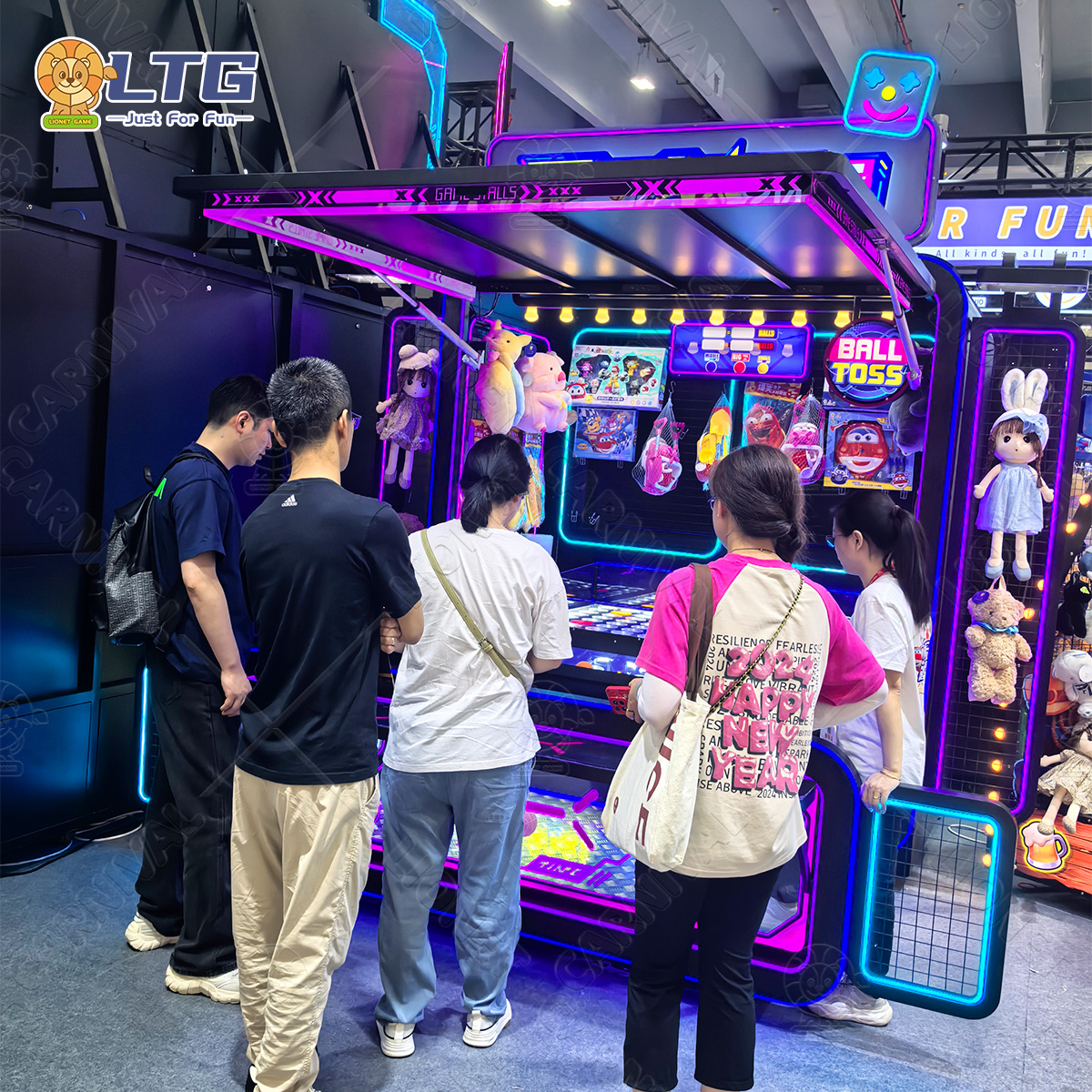
LIONET's Container Carnival Booth is an original outdoor carnival game design that can be evaluated for amusement parks, theme park game zones, outdoor play areas, resort activity grounds, shopping plazas, open-air commercial destinations, and festivals. The booth features a cyberpunk-style modular structure, a one-touch electric door, two-player ball-toss and ring-toss game options, and LED, sound, and interactive visual effects.
Its published dimensions are 3,040 × 3,100 × 3,170 mm, with a listed weight of 1,200 kg and power of 1,100 W. Buyers should confirm ground conditions, overhead clearance, delivery access, electrical connections, door movement, and visitor circulation for each intended site. Proposed indoor installation requires separate confirmation with LIONET.
Why Different Outdoor Venues Need Different Carnival Game Plans
An amusement park, open-air retail plaza, outdoor play area, resort, and festival do not all operate in the same way. Some visitors arrive specifically for carnival games; others discover attractions while walking between shops, entertainment areas, and event activities. The booth should be easy to identify and understand without disrupting existing pedestrian routes. Operators need space for active players, spectators, queues, staff, and prize handling.
Across these outdoor settings, the Container Carnival Booth offers a modern, container-inspired alternative to traditional circus-style stalls. Its LED lighting and interactive winning effects contribute to a recognizable prize-game presentation, while the published two-player arrangement helps operators define player positions. LIONET presents the model within its original carnival game design and manufacturing range in China.
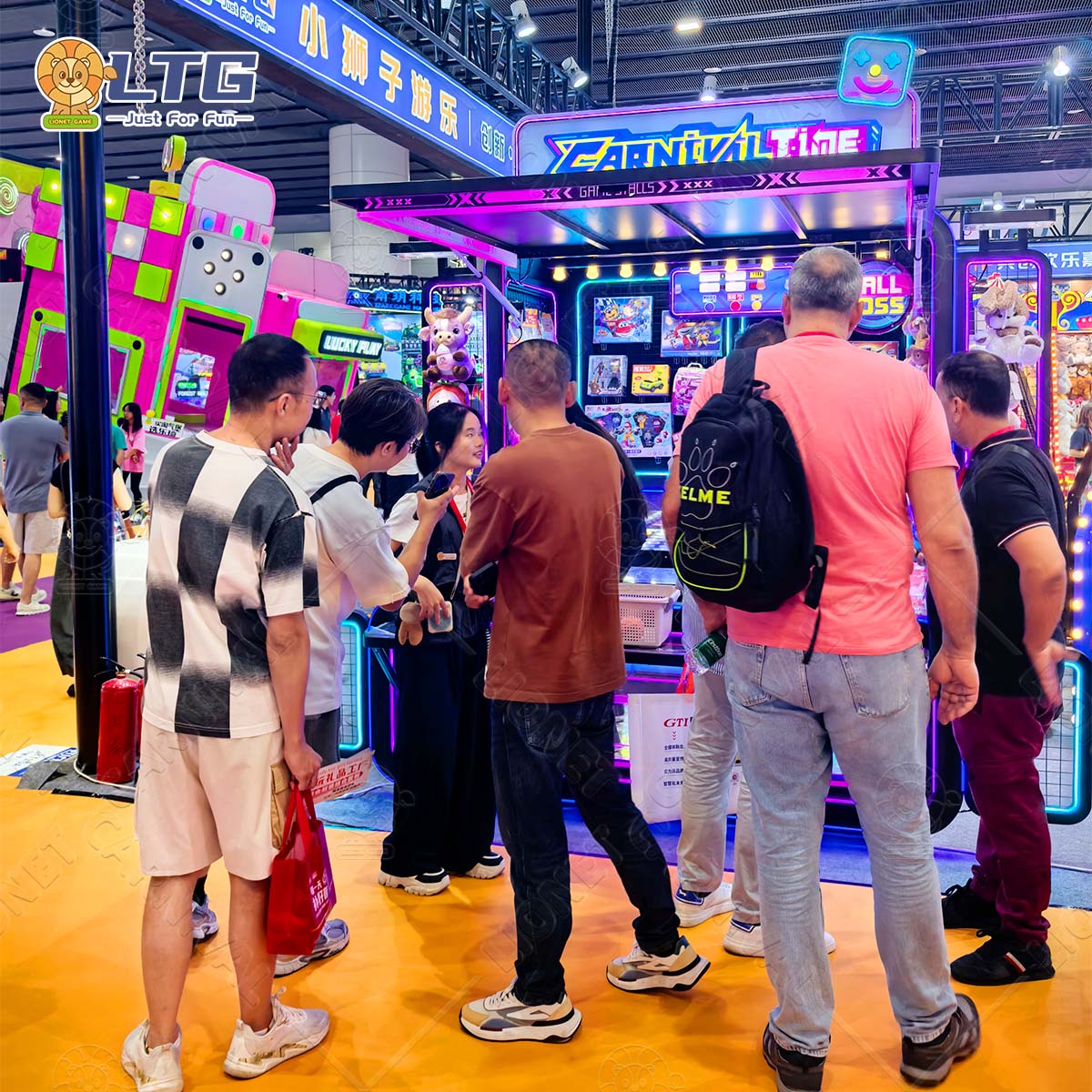
LIONET's official product description emphasizes outdoor entertainment and rain protection, and lists amusement parks, resorts, outdoor events, festivals, and shopping malls among potential applications. Outdoor playgrounds and theme park sections can be evaluated as possible site types, but suitability must be confirmed for the actual visitor profile and location. A general application list is not confirmation of unrestricted indoor use. Check ground-bearing conditions, overhead obstacles, delivery access, power connections, electric-door clearance, and the manufacturer's operating instructions before approving any venue.
Who is this guide for?
This guide is intended for amusement park and theme park buyers, outdoor play-area operators, resort entertainment teams, shopping plaza managers, festival organizers, event rental companies, and international B2B distributors assessing LIONET's original carnival game equipment. It is relevant to both temporary outdoor activations and longer-term carnival attraction areas, subject to the selected site's operating requirements.
The guide does not replace a site-specific equipment drawing, operating manual, electrical specification, or installation plan. Confirm the actual outdoor venue conditions and selected game configuration before purchase.
Published Container Carnival Booth Specifications
The following table separates product facts from buyer decisions. Specifications come from LIONET's public Container Carnival Booth product page. Details not listed publicly should be requested for the exact order rather than inferred.
| Item | Published specification | What outdoor venue buyer confirm |
|---|---|---|
| Product | Container Carnival Booth | Exact product variant and final configuration |
| Brand | LIONET | Original carnival game designer and manufacturer in China |
| Players |
2
|
Where both players and waiting guests will stand |
| Dimensions (W × D × H) | 3,040 × 3,100 × 3,170 mm | Actual occupied area plus operational clearance |
| Weight | 1,200 kg | Unloading, ground-bearing conditions, and handling plan |
| Listed power | 1,100 W | Voltage, frequency, connections, and site supply |
| Material categories | Acrylic and metal | Final component list and cleaning guidance |
| Design | Modular, cyberpunk container style | Appearance and arrangement of the selected unit |
| Door | One-touch electric door | Door travel, controls, and opening procedure |
| Game examples | Ball toss and ring toss | Included game equipment and prize rules |
| Visual and audio effects | Dynamic LEDs, celebration sounds, interactive visuals | Demonstration and venue operating settings |
| Mobility | Caster wheels | Movement route and positioning instructions |
| Outdoor feature | Rain protection | Intended operating and storage conditions |
| Published minimum order | 1 unit | Price, packaging, shipping, and order scope |
Important: The listed 3,040 × 3,100 mm base is the equipment footprint, not the full outdoor plaza operating area. Additional space may be needed for players, queues, staff access, electric-door movement, and equipment handling. The published product specifications do not establish a fixed perimeter clearance; request a drawing for the selected configuration.
Plan Five Operating Zones for Outdoor Carnival Sites
A rendering can help visualize the attraction, but site approval requires a dimensioned drawing. Whether the booth is planned for a theme park, outdoor playground, resort, shopping plaza, or festival, map the structure, electrical supply, visitor circulation, service access, surrounding attractions, and the following five operating zones.
1. Equipment and Door-Movement Zone
Mark the booth's published exterior dimensions on an outdoor site drawing. Request LIONET's final drawing of the electric door in its open and closed positions. Keep temporary displays, landscaping elements, barriers, and waiting visitors outside the required door-movement area once that clearance has been confirmed.
2. Two Active Player Positions
The public specification lists two players. Confirm whether the selected game requires standing, aiming, throwing, or other actions beyond the cabinet edge. For ball toss and ring toss, ask the team to demonstrate the exact standing positions, game targets, collection of playing items, and reset process.
3. Waiting and Spectator Area
At outdoor amusement and entertainment venues, companions and passing visitors may stop to watch the game. Identify separate areas for active players, waiting guests, and spectators, while keeping park paths, venue entrances, retail frontage where relevant, and neighboring attractions clear. Set the queue arrangement according to the selected game and the site's expected attendance.
4. Prize Display and Staff Service
The product presentation highlights prize display and celebratory feedback. Ask how prizes are arranged, when staff intervene, how items are replenished, and where spare stock can be kept without reducing the playing space. Confirm whether your particular game selection has a manual award process or another documented method; the general description alone does not establish automatic prize delivery.
5. Power and Back-of-House Access
Plan the electrical point and cable route with the venue's outdoor site team, using the published 1,100 W figure only as an initial reference. Confirm final supply requirements through the equipment documentation. Also map how the 1,200 kg booth will be unloaded and moved to its position, considering outdoor surface conditions, changes in ground level, and safe handling instructions.
| Operational zone | Question to answer before approval |
|---|---|
| Booth envelope | Is there space for the complete structure and required height? |
| Door operating area | What clearance is required while the electric door moves? |
| Player positions | Can two people participate without occupying circulation routes? |
| Queue and spectators | Where will visitors wait and observe without obstructing shops? |
| Staff, prizes, power | Can the team restock and operate the game without crossing player traffic? |
Design the Full Two-Player Prize-Game Journey
The purpose of an outdoor carnival attraction is not simply to position a booth. Visitors should be able to recognize the game, understand its objective, take a turn, and complete the prize interaction without obstructing normal venue circulation. LIONET lists ball toss and ring toss as game examples, but the exact rules and included accessories must be confirmed for the selected order.
| Stage | What guests need | What the operator should verify |
|---|---|---|
| Notice | A recognizable attraction and visible game area | Sightlines, signage position, and surrounding retail activity |
| Understand | A short explanation of the selected challenge | Real rules, player age considerations, game demonstrations |
| Join | A clearly identified position for each player | Two-player staging, queue management, staff presence |
| Play | Clearly visible targets and a defined round | Throwing distance, target layout, reset steps |
| Celebrate | Recognizable result and audio/visual feedback | How LEDs, sound, and visuals trigger in the selected game |
| Finish | A transparent prize process and exit route | Prize policy, replenishment, stock, and guest departure |
This journey is a planning model, not a statement that LIONET supplies a specific payment system, ticket reader, automatic scoring feature, or prize dispenser. If these capabilities matter to your venue, ask for a written confirmation and an actual product demonstration.
Decide the prize model before selecting the game
Commercial buyers should agree on the prize experience early. For example, a retail brand activation might emphasize a simple, welcoming challenge, whereas a permanent FEC may want more skill variety and a distinct reward structure. The choice affects staffing, consumable items, display arrangement, and per-round procedures. LIONET's general product page does not publish a universal prize cost, reward probability, or guaranteed win rule for every game configuration.
Electric Door, Lighting, and Sound: Three Demonstrations to Request
The most recognizable features of this container carnival booth are the electric door and the celebratory audiovisual treatment. For a mall or FEC project, ask to see each feature operating in context rather than relying only on a promotional image.
Demonstration A — Opening and closing. Request a continuous video or live demonstration showing the one-touch electric door in both directions. Confirm who operates it, where controls are located, what must remain clear, and how the equipment is left at closing time. A one-touch door does not mean that complete unloading and installation happen automatically.
Demonstration B — Full gameplay cycle. Watch a real round of the selected ball-toss or ring-toss game from preparation through reset. Ask what the operator touches, what players interact with, how used items are collected, and how the next round begins.
Demonstration C — Winning feedback. Ask to see the LEDs, celebration sounds, and interactive visuals triggered by the actual game condition. Discuss how the effects fit a mall environment with other tenants and activities. Volume, lighting controls, and operating restrictions should be confirmed, not assumed.
A useful approval pack would connect each video to the same configuration being quoted. Otherwise, a demonstration may show features from a different game combination.
When to Choose One Booth, Several Booths, or a Different Station
LIONET describes a modular structure that can support combining multiple Container Carnival Booth units into a larger carnival area. This can be relevant for operators who want a coordinated visual theme, but the exact arrangement, connections, and service requirements are project-dependent.
| Concept | Buyer objective | Key question |
|---|---|---|
| One Container Carnival Booth | Introduce a distinctive two-player prize game | Is the complete guest and service footprint suitable? |
| Two separately planned container booths | Present two activity points within one promotion | How will queue areas, door movements, and power be arranged? |
| Several container booths | Create a visually coordinated game area | Can the venue accommodate the actual equipment and logistics for every unit? |
| Double Fun Carnival | Evaluate an explicitly indoor, four-player multi-game station | Would its published indoor format suit the permanent FEC brief better? |
The alternative Double Fun Carnival is described by LIONET as an indoor carnival game station for four players. It is not an identical product: its format, player count, dimensions, and operating concept differ. Use it only as a comparison option for a mall or FEC buyer, not as a claim that the Container Carnival Booth is unsuitable indoors.
For wider product research, browse LIONET's indoor carnival games and outdoor midway booths. Decide first what the venue is trying to achieve, then compare individual equipment models.
What to Ask a China Carnival Game Manufacturer Before Ordering
A buyer searching for a carnival game manufacturer in China needs more than an attractive product photograph. LIONET identifies itself as a designer and manufacturer of original carnival games, and the Container Carnival Booth demonstrates a distinctive combination of container-inspired structure, electronic presentation, and familiar midway gameplay.
When evaluating this original design, use a concise evidence-based procurement process:
- Confirm the model. Obtain the exact product name, ordered game content, and included-parts list.
- Request final drawings. Check exterior dimensions, door travel, player positions, and service areas.
- Review the power requirements. Verify supply voltage, frequency, cable arrangement, and the equipment's actual electrical details.
- Inspect a game demonstration. Confirm targets, player actions, prize handling, and resetting steps.
- Review the audiovisual sequence. Check how winning events trigger lights, sound, and interactive visuals.
- Plan transportation. Ask for packing details, unloading instructions, movement route, and handling guidance for the listed 1,200 kg unit.
- Check operating materials. Request instructions covering opening, closing, routine checks, cleaning, and replacement items.
- Request a complete quotation. Specify quantity, destination, commercial scope, expected operating dates, and any required written clarifications.
These are questions to ask, not a claim that every feature, document, service level, or delivery arrangement is automatically included in every order. Avoid confirming venue feasibility from a concept render alone.
Compare total operating needs, not only purchase price
A budget should include the quoted equipment scope plus site preparation, power arrangements, freight, unloading, staff activity, prize stock, and planned maintenance. Each venue's operating model is different. The published product page does not provide a verified hourly revenue figure, throughput guarantee, return-on-investment rate, or universal setup time; those should not appear as promised outcomes in a buyer's business case.
For a temporary mall installation, the most useful early decision is whether the guest and staff journey is practical for the duration of the event. For a permanent FEC, compare the selected game with other indoor-focused LIONET models and consider recurring operation rather than opening-day appearance alone.
A Practical RFQ Template for Outdoor Attractions and Event Buyers
Use the following information when submitting your inquiry to LIONET :
-
Venue: Amusement park, theme park, outdoor play area, resort activity zone, open-air plaza, or festival site.
- Location and dates: country, destination, expected opening period, and intended duration.
- Space: outdoor site plan with overhead clearance, ground conditions, delivery access, and surrounding pedestrian routes.
- Equipment: Container Carnival Booth, quantity, and preferred game examples.
- Operation: expected visitor profile, intended prize policy, and staff responsibilities.
- Technical details: known local electrical supply, unloading constraints, and preferred documentation.
- Approval needs: product video, final drawings, included-parts list, quote, and packing information.
The published minimum order quantity is one unit, but that does not establish a fixed price or delivery schedule. Confirm commercial terms for your specific order.
Frequently Asked Questions
1. Is the Container Carnival Booth designed for indoor or outdoor use?
LIONET presents the Container Carnival Booth as an outdoor carnival game booth, with applications including amusement parks, outdoor events, resorts, and commercial entertainment locations. Shopping-center outdoor plazas and open-air retail event areas may be considered subject to site requirements. Indoor installation should not be assumed from the general application list and must be confirmed with LIONET for the exact configuration and venue.
2. How many people can play simultaneously?
The published configuration provides two player positions. Confirm the layout and play sequence for the particular game being ordered.
3. What is the size of the Container Carnival Booth?
The listed equipment dimensions are 3,040 × 3,100 × 3,170 mm (width × depth × height). The total operating area must also include players, queues, the door's movement, and staff access.
4. What electrical requirements should an outdoor venue confirm?
The published power figure is 1,100 W. Confirm voltage, frequency, connections, cable routing, and the actual site supply with LIONET and the venue team before installation, regardless of whether the attraction is in a park, plaza, resort, or festival area.
5. Does the electric door open the entire booth automatically?
The product description specifies a one-touch electric door. It does not establish fully automatic installation or a fixed setup time. Request a demonstration of the door and the complete operating procedure.
6. Which games are listed for this booth?
Ball toss and ring toss are named examples. The exact included games, targets, accessories, and prize method should be confirmed in the quotation.
7. Does the booth automatically deliver a prize?
The public product description highlights prize gameplay and celebration effects, but it does not confirm an automatic prize-delivery mechanism for every configuration. Ask to see the complete award process.
8. Can multiple Container Carnival Booth units be arranged together?
The official description refers to combining multiple modular units into a larger carnival area. The precise physical arrangement and any connections or shared controls must be confirmed for the proposed project.
9. Do caster wheels mean the booth can move across any outdoor surface?
No such guarantee is published. The booth weighs 1,200 kg, so the buyer and manufacturer should review outdoor ground conditions, unloading, handling procedures, movement routes, and instructions for positioning the equipment.
10. What should I send LIONET to receive a useful quotation?
Send the intended venue, drawings, game preference, quantity, destination, operating dates, and any known delivery or electrical constraints. Ask for the final product configuration, packing details, price, and delivery terms through the official contact page.
Conclusion
The Container Carnival Booth can be evaluated for a range of outdoor entertainment settings, including amusement parks, theme park game zones, outdoor play areas, resort attractions, open-air plazas, and festivals. Its original cyberpunk-style container design, two-player format, one-touch electric door, and audiovisual winning effects distinguish it from conventional midway stalls.
The published dimensions, weight, and power offer a starting point, while final suitability depends on the individual venue's ground conditions, overhead space, electrical supply, door clearance, visitor circulation, and game configuration.
As a China-based original carnival game designer and manufacturer, LIONET can discuss game options, product configurations, and outdoor venue requirements with international buyers. Share the intended park, playground, resort, plaza, or event layout, then request the final specifications, demonstration, handling instructions, and quotation needed for a well-informed purchase decision.